


By Steven Muskal, Ph.D.| April 2026 // stevenmuskal.com
There is a moment in the development of every civilization-altering technology when the nature of the change becomes undeniable. We have passed that moment with AI.
I have spent my career at the intersection of chemistry, molecular biology, and artificial intelligence. I hold a B.Sc. in engineering chemistry and computer science from Colorado School of Mines and a Ph.D. in biophysical chemistry from UC Berkeley. I have been fortunate. Those credentials opened doors, granted access, placed me in rooms where ideas could travel. I say this not to boast but to acknowledge a reality that has troubled me for most of my professional life: the doors those degrees opened were not universally available. Not by a long shot.
The credential has been, for most of human history, the gatekeeper. Not just for opportunity, but for the very permission to be taken seriously. If you did not have the right institution on your resume, the right letters after your name, the right connections through those networks, your ideas, however brilliant, existed in a kind of social vacuum. They could not propagate. They could not compound.
AI changes that. Not incrementally. Fundamentally.
What We Lost Along the Way
Think about the minds we left behind.
Thomas Edison spent barely three months in formal schooling before his teacher declared him “addled.” His mother, Nancy, refused to accept that verdict. She pulled him out and educated him herself, surrounding him with books, experiments, and the radical notion that his relentless curiosity was an asset, not a deficiency. The man who gave us electric light, the phonograph, and the motion picture camera was, by institutional standards, uneducable.
Marie Curie wanted nothing more than to study science. Poland would not allow it. As a young woman under Tsarist Russian rule, she attended what was called the Flying University, a clandestine network of educators and students who met in secret, rotating locations to avoid detection, because the official institutions were closed to women and to Poles seeking education in their own language. She eventually made her way to Paris. She won two Nobel Prizes. In two different sciences.
Albert Einstein did not fail school in the simple sense that the legend sometimes implies, but he chafed relentlessly against rote memorization and rigid authority. He thrived when imagination was invited into the room and suffocated when it was not. His thought experiments, the ones that rewrote our understanding of space and time, were not products of institutional machinery. They were acts of unconstrained curiosity.
Linus Pauling grew up in modest circumstances in Oregon, the son of a pharmacist. He drove his own intellectual development with ferocious intensity, eventually producing foundational work in quantum chemistry, molecular biology, and the nature of the chemical bond, work that touched everything from protein structure to our understanding of disease. He won the Nobel Prize in Chemistry. And then, years later, the Nobel Peace Prize.
Here is the question I find myself returning to: what would these minds have accomplished if, at age fourteen or seventeen or twenty-three, they had access to an AI that could engage them at full depth? That could answer every question, suggest the next one, locate the obscure monograph, help them visualize the molecular geometry, challenge their assumptions with precision and patience?
My instinct is that we have barely begun to imagine the answer. Perhaps more advanced cancer therapies arrived at decades earlier. Perhaps deeper probes into the structure of matter. Perhaps the cellular reprogramming insights we now associate with stem cell science, discovered not in elite university labs but in a kitchen in Appalachia or a one-room school in sub-Saharan Africa.
We will never know what we lost. But we can change what comes next.
The Reframing of Education
What does it mean to be educated?
For most of my lifetime, the answer has been institutional. You attended. You completed. You were credentialed. That credential became the proxy for capability, for trustworthiness, for the right to be heard in professional and intellectual discourse.
AI does not care about your transcript. It engages with your question on its merits.
I am not suggesting credentials are worthless. I have them, and they served me well. But I am saying that the credential was always an imperfect proxy. The underlying thing we actually valued was not the degree. It was curiosity, rigor, the ability to ask good questions and pursue good answers. The credential was merely the most available signal for those qualities.
AI provides a new signal. And unlike the credential, it is globally accessible. Anyone with curiosity, and an internet connection, can now engage in substantive, advancing, intellectually serious dialogue on virtually any subject. The playing field is not yet level; access to connectivity remains deeply unequal. But the direction of the arc is unmistakable.
This is the democratization of intelligence. Not dumbing it down. Not making it easier. Making it more available. Distributing it across the full range of human potential rather than reserving it for those born into proximity to elite institutions.
Boiling the Ocean
There is a category of problem I think of as “Boil the Ocean” challenges. These are not problems that any individual, however brilliant or well-funded, can solve alone. They require massive network effects. They demand that a change in understanding propagate across cultures, languages, economic strata, and geographies simultaneously.
Global health and wellness is the most obvious of these. Collective scientific advancement is another. The elimination of preventable disease. The reorientation of human behavior toward prevention rather than late-stage intervention.
A collaborator of mine made an observation recently that stopped me cold. He pointed out that the decision not to smoke has had a greater positive impact on cancer outcomes over the past half-century than all chemotherapy treatments combined. Let that sit for a moment.
We have spent extraordinary resources, intellectual capital, and human suffering learning to treat a disease that, in a significant proportion of cases, was preventable. The cure is heroic and necessary. The prevention is transformative.
AI-enabled lifestyle intelligence, the kind that can meet a person where they are, in their language, in their cultural context, with actionable and personalized guidance, has the potential to move the needle on prevention at civilizational scale. Not for the wealthy patients in major medical centers. For everyone. That is a Boil the Ocean moment. Raise all boats, all at once, through better information, better behavior, better choices made earlier. The math on that is staggering.
These are the projects that no single institution, no single government, no single billionaire can drive alone. They need a framework that propagates. They need network effects that cross the borders we have drawn between disciplines, between geographies, between economic classes. AI, deployed thoughtfully and equitably, is uniquely suited to be that framework.
The Fire Analogy, and Why It Matters
I have heard AI compared to the printing press. I understand the impulse. The printing press democratized the written word, broke the monopoly of the ecclesiastical class on literacy, and triggered centuries of social transformation.
But I think the more honest comparison is to fire itself.
Fire was not the printing press. Fire was not an improvement on what came before. Fire was a fundamental reordering of what was possible. It changed human metabolism, social structure, geographic range, and cognitive capacity. It enabled cooking, warmth, light, and metallurgy, and eventually every other technology that followed. It was also terrifying, uncontrollable, and dangerous, a source of justified fear in exactly the same proportion as it was a source of capacity.
There is a real and understandable anxiety about AI. Jobs displaced. Expertise devalued. The vertigo of watching something outperform humans in domains we used to reserve for ourselves. I do not dismiss those fears. They are not naive. The people who express them are not Luddites; they are paying attention. But I think the response to fire was never to extinguish it. The response was to learn how to carry it safely, to build hearths, to develop the culture of its responsible use.
That is where we are now. We are building the hearth.
What concerns me more than the technology is the possibility that we build those hearths only in certain neighborhoods. That we allow the democratizing potential of this moment to be captured, filtered, and concentrated by the same forces that made the credential a gatekeeper in the first place. That would be a tragic misuse of the most powerful fire humanity has ever kindled.
Where We Go From Here
I am, constitutionally, an optimist. My career has been built on the belief that the tools of science, rigorously applied, can reduce human suffering and expand human possibility. I have seen that belief vindicated more often than not.
AI does not change my optimism. It amplifies it.
What I hope for, as this technology continues its extraordinary development, is that we keep the democratizing mission central. That we build the frameworks, the access, the cultural practices, and the policy structures that extend the benefits widely rather than concentrating them narrowly. That we remember the Marie Curies studying in secret, the Edisons labeled and dismissed, the Paulings from nowhere in particular who changed everything.
There are people alive right now, today, who would reshape our understanding of disease or energy or cognition or materials, if only they had the tools and the permission to try.
AI is handing them the tools. Our job is to provide the permission.
The fire is already lit. What we do with it is still up to us.
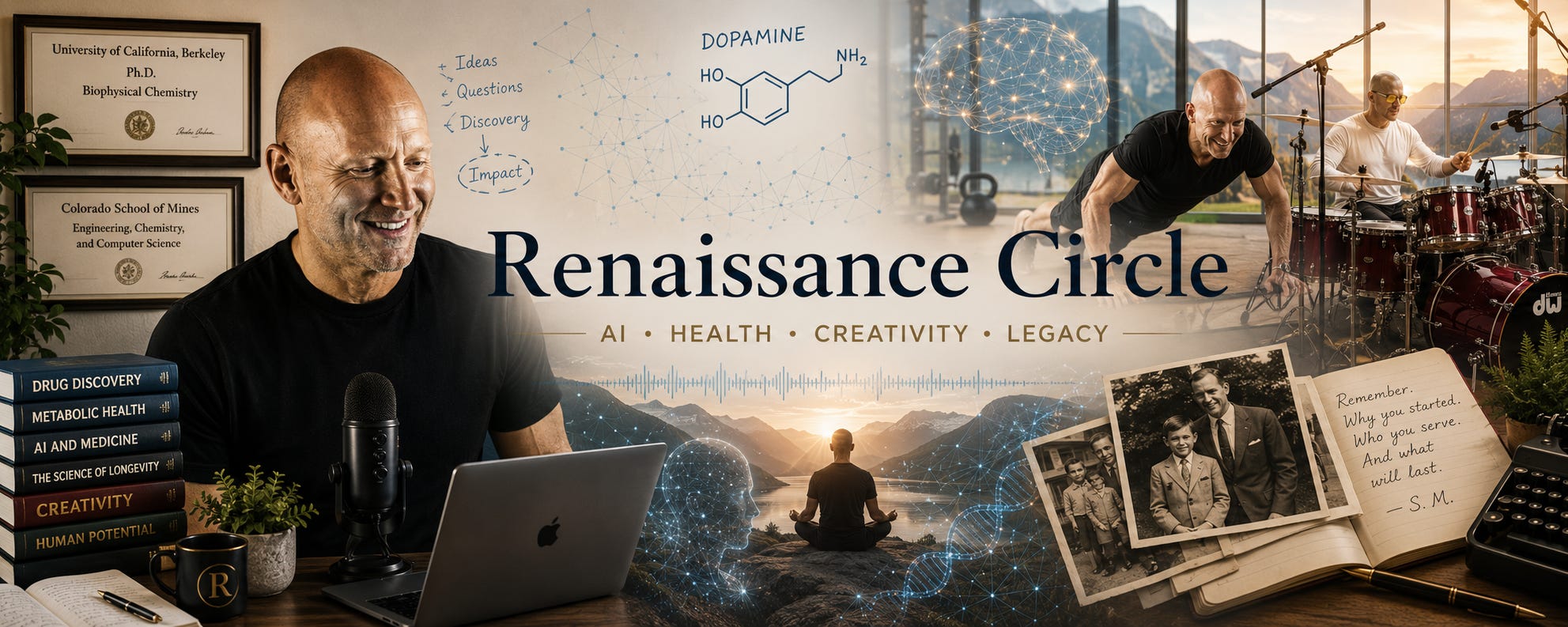
Steven Muskal, Ph.D. is the CEO of Eidogen-Sertanty, Inc. — a drug discovery informatics company. He has spent four decades working at the intersection of computational biology, AI, and drug discovery. He writes about AI, health, and the intersection of biology and technology at stevenmuskal.com
For a couple music-mix videos (I promised doubling up), these are from a recent gathering, again with musicians not having played together before: Dan (Bass/Vocals), Jesse (Guitar/Vocals), and Andrew (Guitar/Vocals). An incredibly productive session, over 18 songs in a couple hours. Single run throughs, and first times for several of us.