


Seven companies now account for roughly a third of the value of the S&P 500. One sponsored market note puts the Magnificent Seven at a 35% peak in June 2026, against a previous high near 26% set twice before, in the 1980 energy boom and at the dot-com top in March 2000. A third of the largest equity market in the world is levered to one buildout thesis, and most of that exposure sits in index funds that retirement savers never chose stock by stock.
The comparison being drawn in many podcasts right now is 1873, Jay Cooke, the Northern Pacific, and a founder with a cult following and a bond desk. The parallel is real. We need to stop treating bubbles as one species. Every one of them runs on two engines, a technological engine and a financial engine, and the engine that dominates tells you what breaks, who survives, and what the wreckage is worth afterward.
Every Bubble Has Two Engines
Carlota Perez made this argument: the installation phase of a technological revolution and the speculative frenzy of financial capital are coupled. A study of 51 major innovations introduced between 1825 and 2000 found equity bubbles in 73% of them, with bubble magnitude rising with how radical the innovation was. The technology is usually not the error. The financing of the technology is where the error lives.
Dominant engine by episode. Both engines run in every case; the question is which one sets the pace.
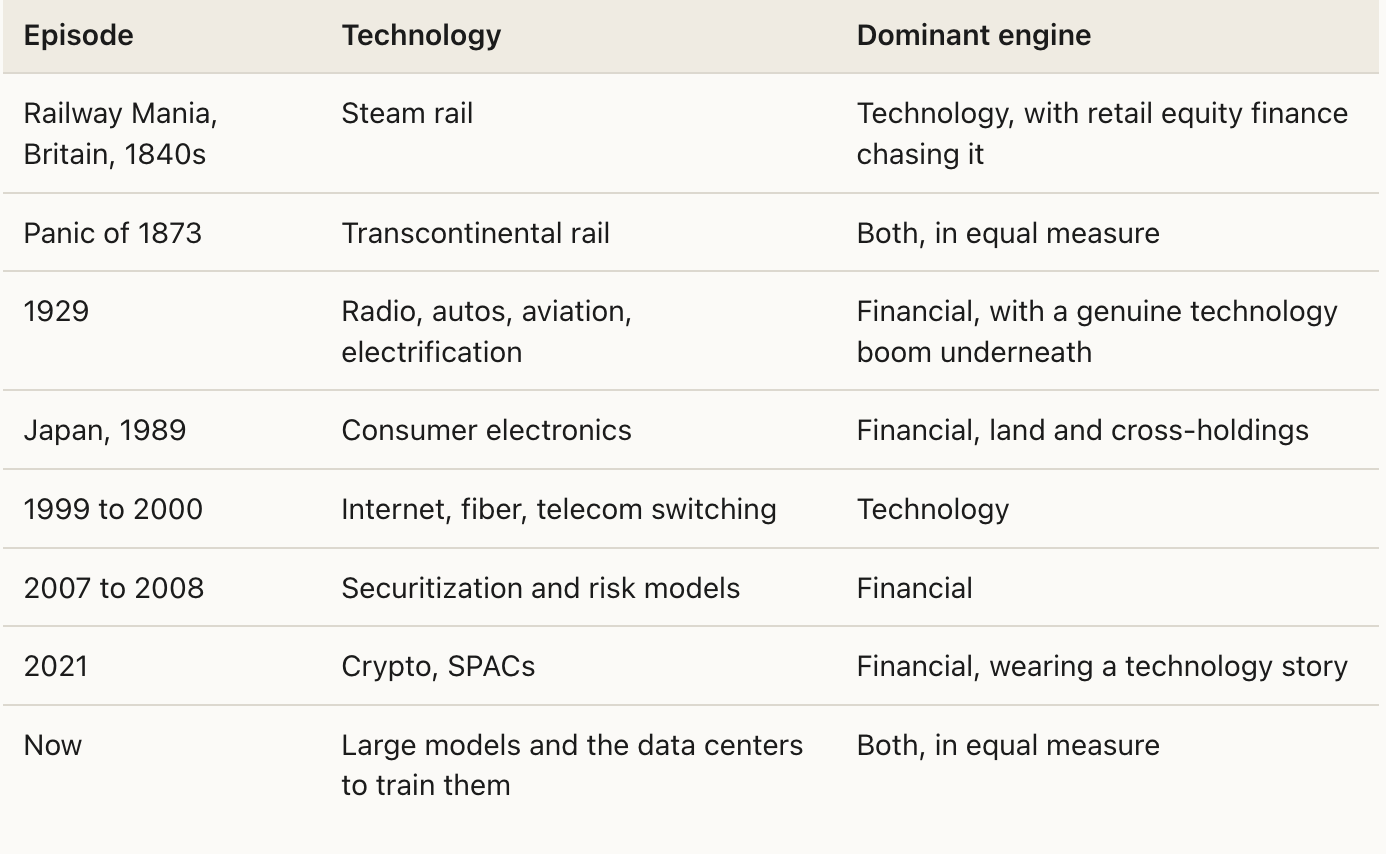
Two entries in that table have both engines at full throttle. One of them is 1873. The other is the one we are living in. That is the reason the 1873 comparison keeps surfacing, and it is a better reason than the resemblance between two charismatic men.
When the financial engine dominates, as in 2008, the assets left behind are houses and loan books, and they reprice. When the technology engine dominates, as in 2000, the assets left behind are physical capacity that outlives the companies that built it, and someone else inherits it cheap. When both engines run hot, you get both outcomes at once: a credit event and a decade of stranded capacity. In 1873 that combination produced a depression that ran, by some measures, six years.
The Cell Runs Two Currencies Too
Biology made this same split. ATP is the energy currency of the cell. GTP is the information currency. ATP is the molecule hydrolyzed to do work, to contract a muscle fiber, to pump an ion uphill, to drive a reaction that would not otherwise run. GTP is used by the cell for switching and timing: the heterotrimeric G proteins behind hormone and light signaling, the Ras family of small GTPases, the elongation factors that gate each step of translation.
The chemical difference is almost nothing. Guanine and adenine are both purines, C₅H₅N₅O against C₅H₅N₅. One oxygen. Counting nitrogen and oxygen sites the way a medicinal chemist does, guanine offers 6 against adenine’s 5, along with one additional hydrogen bond donor. An oxygen takes the place of the amino group, the amino group moves one position over, and a hydrogen settles on the nitrogen between them. Guanine presents a different face, with one more place to make contact.
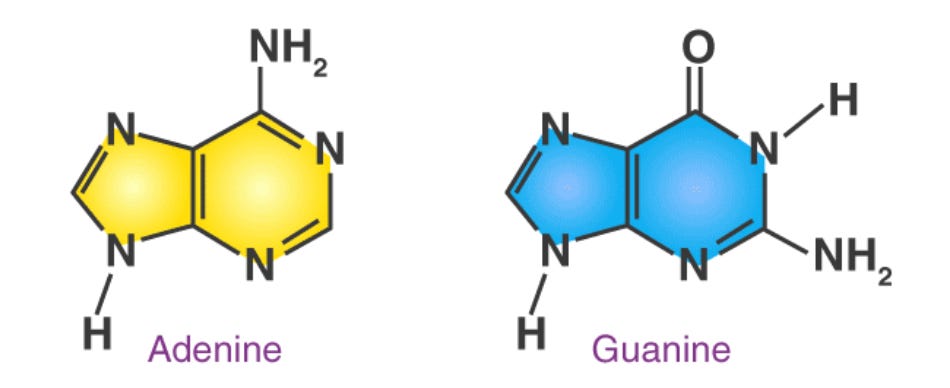

Hydrogen bonds are how molecules speak to each other. They are directional, they are specific, and a protein reads a nucleotide by counting them. The nucleotide that carries information therefore has one more channel of communication than the nucleotide that carries energy, and every extra channel is also an extra place to be perturbed, misread, or hijacked. Signal transduction is built on the richer molecule and it is correspondingly easier to break.
By analogy, the same asymmetry holds for the two engines of a bubble. The financial engine is energy; it moves capital to where capital is called. The technological engine is information; it carries the thesis, the expectations, and the story that justifies the capital. The information side has more surfaces at which a shock lands. That argues for watching the technology engine more closely than the financing, while conceding that both of them can fail, and that in this cycle both of them are running hot.
Jay Cooke Built Railroads Nobody Needed Yet
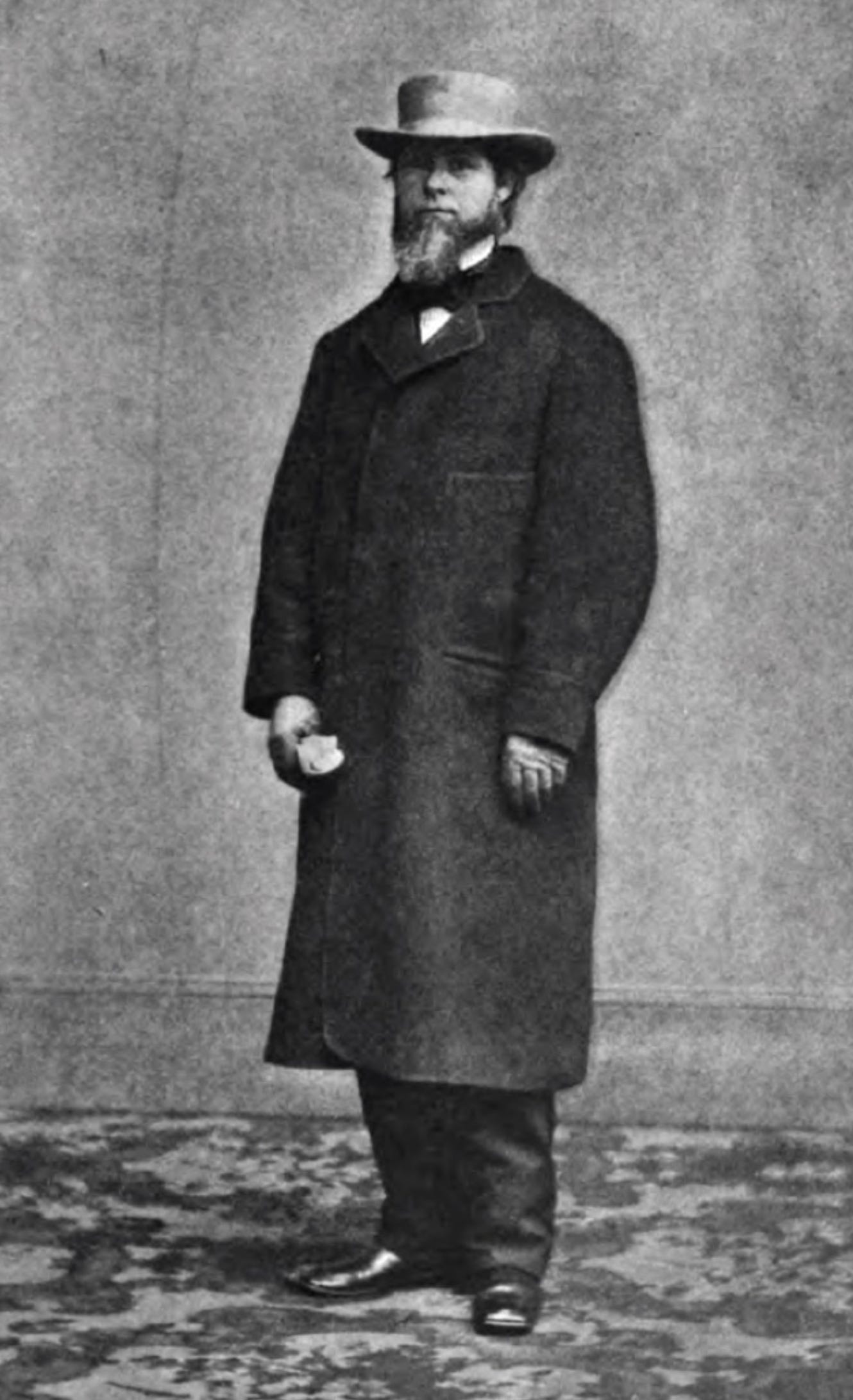
Jay Cooke & Company underwrote the Northern Pacific Railway on the promise that a northern transcontinental line would unlock settlers, freight, and commerce. The vision was correct. The northern route did get built, it did matter, and the territory it opened is still shipping grain. What was wrong was the pace and the structure. Cooke borrowed heavily and sold bonds faster than track demand justified, on the assumption that revenue would arrive before the obligations did.
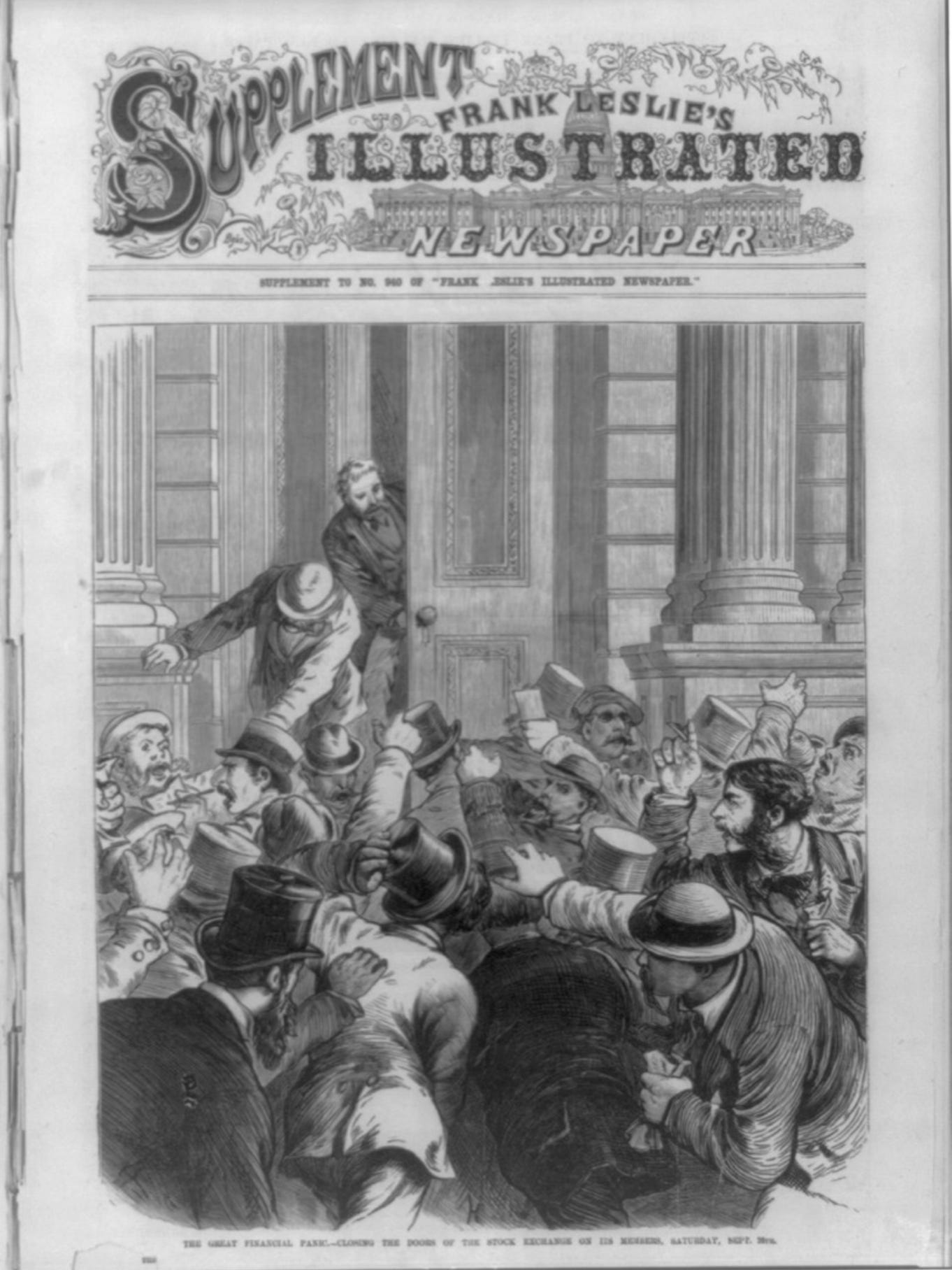
Cooke was not a fraud. He was a believer who financed his belief with other people’s money on a schedule the freight could not meet. His firm failed in September 1873, the New York Stock Exchange closed for ten days, and the Northern Pacific was finally driven to completion in 1883 by other people, with Cooke’s investors long since wiped out.
Cooke’s role has a name in the cell. Nucleoside diphosphate kinase takes ATP and hands back GTP, converting the energy currency into the signaling currency at a fixed rate and creating nothing in the exchange. Cooke did the same with capital and belief, through distribution machinery he had already built selling war bonds to households. He did not invent the locomotive and he did not generate the freight. He converted.
Swap the Northern Pacific for gigawatt data centers, swap the bond syndicate for off-balance-sheet financing vehicles and circular chip-and-cloud supply agreements, and the structural bet is identical. Build the capacity now, on debt, for demand the believers are certain about and nobody has yet metered.
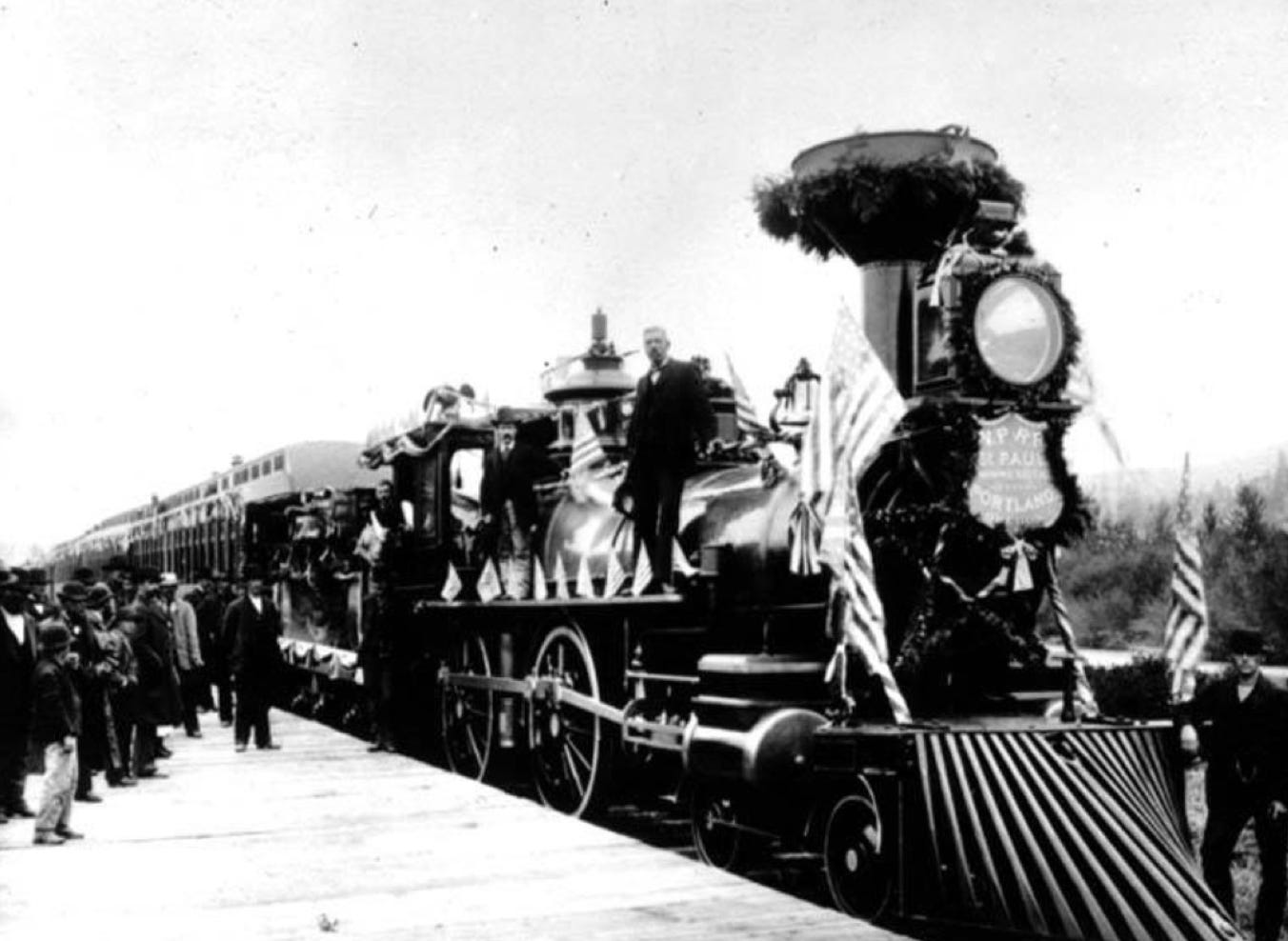
While I agree that this technology is as consequential as rail, I separate two claims that the market has fused into one. That AI will matter enormously is a claim about the technology. That every dollar spent accelerating its physical buildout today will be repaid on the current schedule is a claim about financing. Cooke conflated them too.
Remember the Dot-Com Wasteland
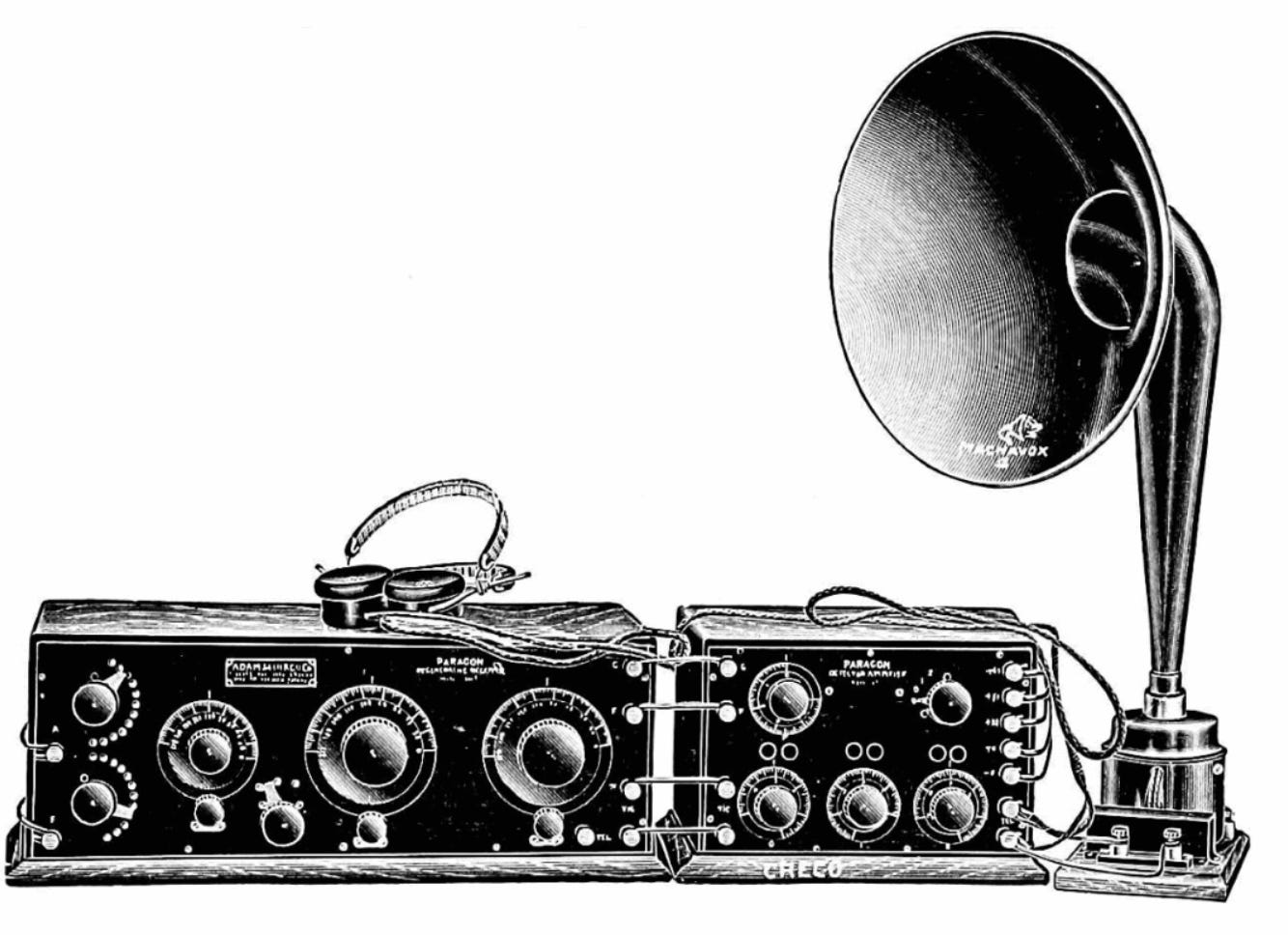
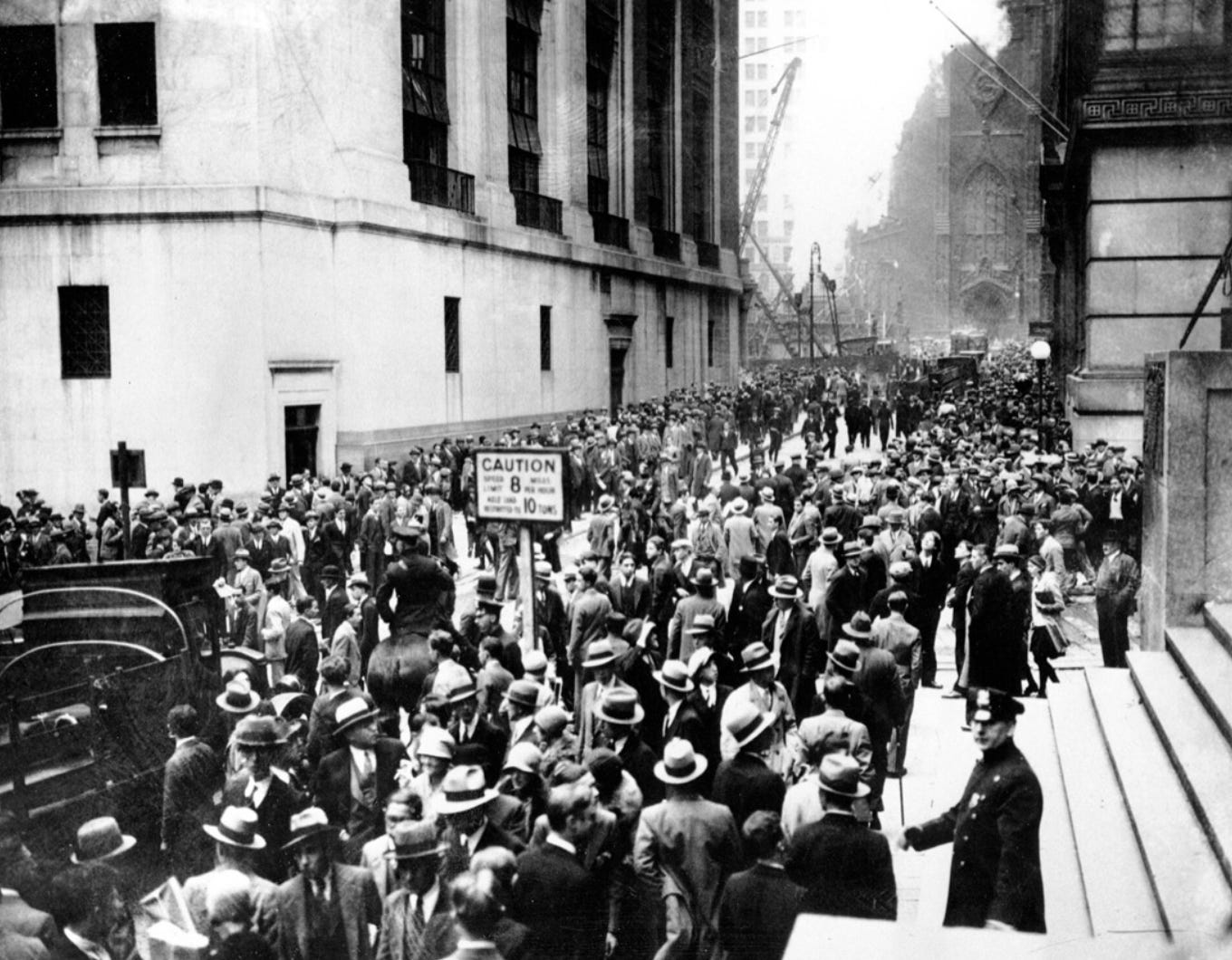
The 1920s had radio. Sets sold into American homes by the millions, broadcasting was genuinely new, and the equities attached to it were bid to levels that assumed the household penetration curve would never flatten. The technology delivered. The valuations did not survive 1929.
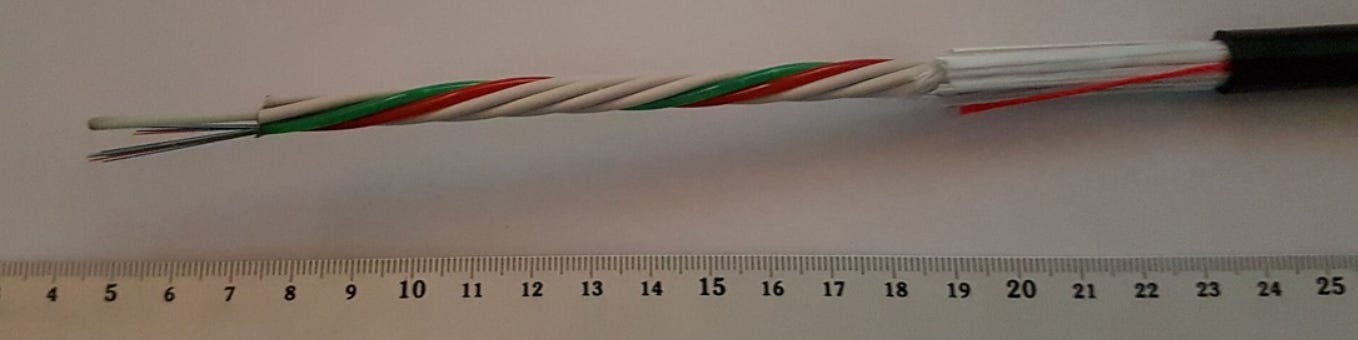
The episode closer to hand is 2000, and the part of it that gets left out is Y2K. Governments and corporations spent extraordinary sums in 1998 and 1999 on remediation, and much of that money moved through the same vendors, switches, servers, and fiber routes that the internet buildout rode in on. When the remediation cliff arrived in January 2000 and the follow-on revenue did not, the capacity stayed in the ground. Dark fiber sat unlit for years. We had built the track ahead of the freight again.
The absurdities of that period are worth recalling only because they were accompanied, at the time, by universal insistence that they were rational. Pets.com bought a Super Bowl ad for a business that lost money on every bag of dog food. Webvan spent close to a billion dollars on warehouses for a model nobody had proven. Graduate students at name-brand universities advertised as egg and sperm donors to cover rent while waiting on options that never vested.
Amazon fell about 95% peak to trough and lived, because underneath the story was a logistics and retail business that generated cash on every order. Google was not even public when the bubble burst; it listed in 2004, after the carnage, on a search advertising model that earned on every query. The survivors had unit economics. The casualties had a story and a burn rate.
Weights, Not Wonders
I have spent forty years building computational and machine learning models, starting with how small molecules bind to proteins and ending up in the tooling that grew out of that discipline. The mechanics drive the investment case.
A large language model is a very large array of numbers. Billions of floating-point weights, in some cases more than a trillion, arranged in matrices and fitted by gradient descent to predict the next token, until the statistics of that prediction task encode something that behaves like reasoning. Nothing in that description is structurally uncopyable. There is no patent-grade secret inside the matrix. Getting there the first time costs an enormous amount of compute and engineering, which is real and deserves to be paid for, and which is not the same thing as a durable structural barrier to entry.
Chinese labs, DeepSeek most visibly, have used distillation, training a smaller model to imitate a larger one’s outputs, to reach competitive performance at a small fraction of frontier training cost, and have published the weights. Those models run today on a workstation. Four-bit quantization brings a 70 billion parameter model down to roughly 40 GB, which fits in one machine under a desk, with no H100 cluster anywhere in the picture.

Dumping, With Weights Instead of Steel
We have seen this film before. China built steel capacity near a billion metric tons a year, well past what its own construction demand could absorb, and exported the surplus. Crude steel output was 960.81 million metric tons in 2025, roughly 52% of the world total of 1.85 billion, while exports hit a record just above 119 million and Chinese hot-rolled coil offered at about $465 a metric ton against $480 from India, $495 from Japan, and $535 from Turkey. Western producers lost on price set by someone with capacity to clear and a reason to clear it.
Open weights are the same move with a crucial difference: the marginal cost of the next copy is zero. Alibaba’s Qwen family already accounted for more than 30% of all Hugging Face model downloads in 2024, and by August 2025 Qwen derivatives were over 40% of new language-model variants on that hub. A government that wants to compress the margin of American model vendors does not need an export terminal. It needs one upload.
Good Enough Is a Business Strategy
We are no longer constrained by model capability. We are constrained by deployment (and content).
The industry’s own behavior says so. The last real jump in usefulness came from spending more compute at inference time, the reasoning models that work step by step before answering, rather than from a larger base model. The pretraining scaling law has hit diminishing returns. Meanwhile the toolkit for extracting value from what already exists has improved faster than the frontier has: quantization that shrinks the memory footprint at minor accuracy cost, speculative decoding, distillation into small specialists, and retrieval that hands a mid-sized model the context of a much larger one. A well-engineered application on a mid-sized open model now beats what a frontier model could do eighteen months ago on the tasks a business actually cares about, at a fraction of the cost per call.
Serving those models has become trivial, and trivial is the operative word. The weights are published, the runtimes are commodity, the hardware is available, and the deployment is a weekend of work for a competent engineer. The scarce thing is integration, product design, data plumbing, and dull reliability engineering. Spending another quarter-trillion dollars on the next training cluster, while most of the economy has not finished exploiting the model it already has, is Cooke laying a fourth parallel line past a town that has not filled its first three cars.
We Are Running Out of Things to Read
There is a harder ceiling than compute, and it gets far less attention. Epoch AI put the effective stock of quality, repetition-adjusted public human text at about 300 trillion tokens and projected that training runs would consume it between 2026 and 2032, sooner under aggressive overtraining. Nature reported their estimate that typical training set size reaches the total stock of public online text around 2028.
Set that against the models. Parameter counts are now quoted in the hundreds of billions, and open-weight releases at a trillion parameters have already shipped. The double-digit trillions of tokens that the web, the libraries, and the archives of human writing represent have largely been absorbed into weight matrices measured in trillions of parameters. The corpus has been read. Access to it is tightening at the same time, as rights holders stop treating crawling as weather.
Compute can be bought and chips can be fabbed. New writing cannot be manufactured by the people who need it.
The Real Moat Is Proprietary Content
Follow that to its conclusion and the defensibility everyone is paying for sits in the wrong place. The weights are copyable. The serving stack is commodity. What is neither is a corpus that nobody else holds and that keeps growing: proprietary data, curated knowledgebases, instrument records, clinical and operational logs, and the working output of people who produce original material for a living.
Writers, researchers, educators, analysts, and curators should read this as leverage rather than threat. They are a dependency, not a casualty. Reported licensing terms are already telling: News Corp’s agreement with OpenAI was reported by the Wall Street Journal at more than $250 million over five years, and Reddit’s IPO filing disclosed data licensing contracts with an aggregate value of $203 million over two to three years. Those are the opening prices in a market where the buyers are running out of alternatives.
The pricing implication is the part creators keep underselling. A corpus rented through low-cost subscriptions earns a few dollars a month per reader. The same corpus licensed for training is an asset sale, and the move from subscription to perpetual license is reasonably a 10 to 100 fold step up in realized value for the contributor.
Better still, the asset regenerates. Models are retrained frequently, and each cycle needs material that postdates the last one. A perpetual license on the 2026 corpus does not foreclose a perpetual license on the 2029 corpus. For a prolific curator, that is an annuity with a new principal payment every cycle, and the way to earn it is to keep producing original, high-quality material that a model cannot source anywhere else.
The Pyramid Balanced on One Point
Layer the market structure back on top. A handful of hyperscalers and the chipmaker that supplies them carry the index. Beneath them sits a dependent tier of specialty cloud providers, utilities signing long-dated contracts for gigawatt loads, and financing arrangements in which the chip supplier, the cloud provider, and the model company invest in each other and contract with each other, which makes end demand difficult to separate from the financing itself. The dot-com telecom sector ran a milder version of this with capacity swaps between carriers that inflated reported revenue without a single new end customer appearing.
This is not a forecast about any one company. It is an observation that when a third of an index depends on a buildout thesis rather than on realized cash flow from that buildout, the overconcentration pattern that preceded every prior technology-driven correction is back, with larger numbers and better marketing.
The Thermodynamics Are Settled. The Kinetics Are Not.
I trained as a chemist before I wrote software, and the instinct that leaves you with is about gradients. Capital is flowing into AI infrastructure at a rate decoupled by a wide and widening margin from the cash flow that infrastructure currently produces. A gap like that is a pressure differential, and pressure differentials equalize. A supersaturated solution crystallizes eventually, and the identity of the speck of dust that starts it is almost beside the point.
What is genuinely open is the rate. Maybe a financing vehicle fails to refinance. Maybe one quarter arrives in which a hyperscaler concedes that capex is not converting to revenue on schedule. Maybe open weights land at a capability that makes a frontier subscription hard to defend on price. I do not know the trigger and I do not know the quarter. I am confident about the direction.
Keep the Powder Dry, and Keep Writing
Two lessons follow, and they point in the same direction.
The first is dry powder. Hold more cash than is comfortable, more than a model portfolio prescribes, and more than the fear of missing the next 10% wants you to hold. The investors who did best out of 2000 were not the ones who squeezed the last few points out of the rally. They were the ones with money available when Amazon traded in single digits and the survivors were priced at wartime rather than peacetime. The correction, when it comes, will not end AI. It will be the moment when companies with real unit economics buy their way into dominance, the way Google and Amazon did, while the firms that financed capacity ahead of the freight get reorganized quietly.
The second is content. If you write, research, teach, record, or curate, your material is the input that is actually running short, and it is the only part of this stack that cannot be distilled out of someone else’s model. Produce it, keep the rights to it, catalog it, and price it as the strategic asset it has become. The systems will be back for more in a few years, and they will need what you made after the last time they asked.
You can stay fully invested and hope the kinetics stay slow. Or you can hold your powder, keep producing the one thing the models cannot generate for themselves, and be solvent and useful on the other side. I know which one I am doing.
References
Carlota Perez, “The Advance of Technology and Major Bubble Collapses”: carlotaperez.org
“Two Centuries of Innovations and Stock Market Bubbles”: ResearchGate
Dot-com bubble: Wikipedia
S&P 500 concentration, Magnificent Seven peak: Institutional Investor (sponsored content, CME Group)
Knowledge distillation: Wikipedia; DeepSeek-R1 (arXiv:2501.12948): arXiv
Epoch AI, “Will we run out of data? Limits of LLM scaling based on human-generated data”: epoch.ai
China steel output, exports, and price offers, 2025: SunSirs, SMM
News Corp and OpenAI licensing terms as reported: Yahoo News, citing the Wall Street Journal
AI content licensing deal tracker: LLMPulse

About the Author: Dr. Steven Muskal is CEO and founder of Eidogen Sertanty, with more than four decades of experience in AI driven drug discovery. He holds a Ph.D. in Chemistry from UC Berkeley (1991), where his thesis focused on neural networks for protein structure prediction.