


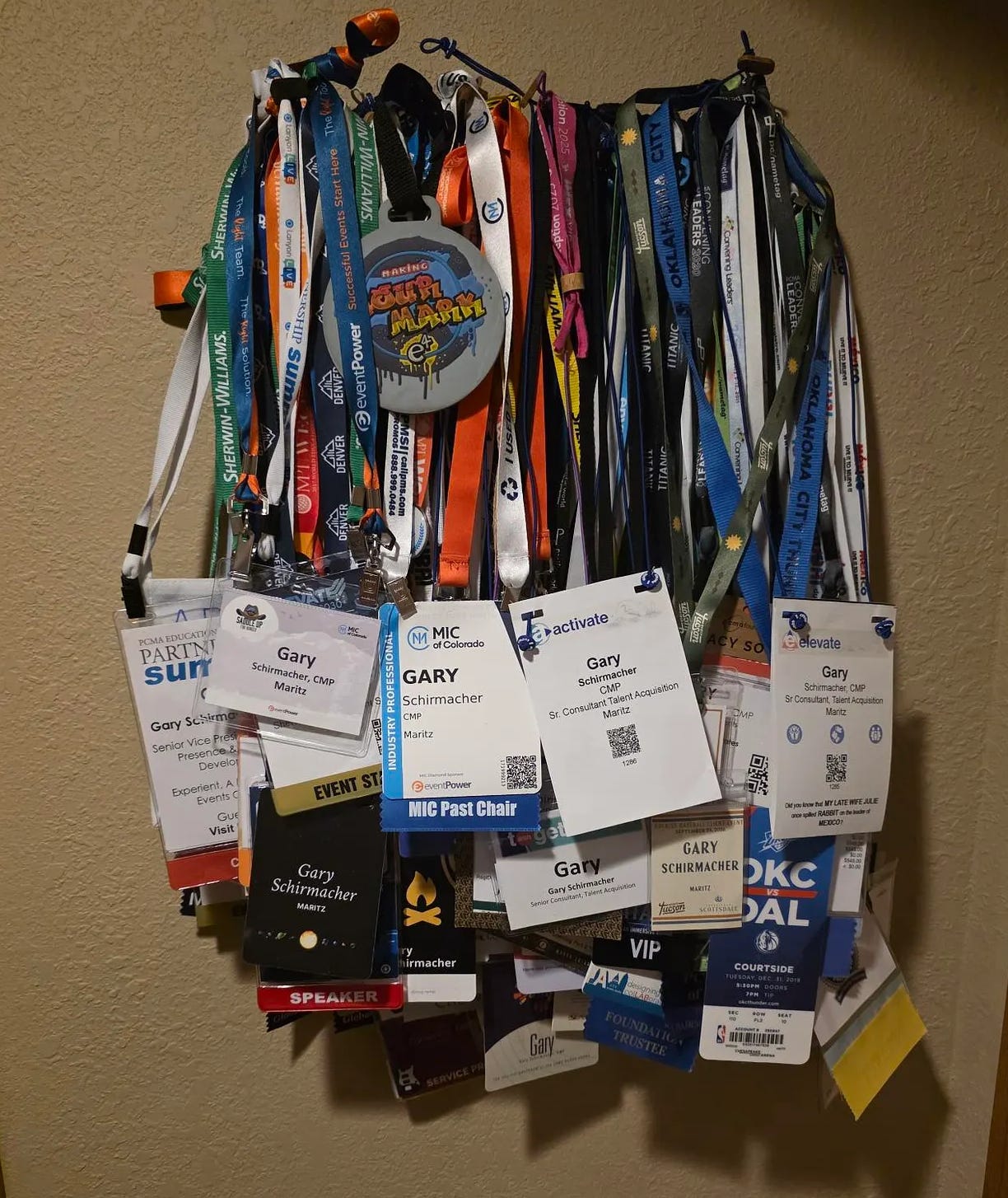
Before we recorded, Gary Schirmacher sent me a photo of what hangs behind his office door. Dozens of conference lanyards in one thick bundle, each with a name badge at the end. Speaker. VIP. Event Staff. Foundation Trustee. MIC of Colorado Past Chair. The collection is ridiculous. I figured it was a career’s worth. Gary told me it’s the last seven or eight years.
Gary and his daughter Abby are starting a Substack and podcast called Nasty Networking. I’ve known them both for a bunch of years, and this Renaissance Circle conversation was their first time putting it on the record. I opened with Scott Galloway’s question: where does this podcast find you?
It found them in Gary’s house in Erie, Colorado, in Boulder County, sharing one screen in the second office, with Bear, their Great Pyrenees shepherd mix, at their feet. Bear had opinions later.
Nasty, as in nasty good
When I first heard the name, I had questions. By the end of the conversation, we had found quite a few ways to use it. Gary’s explanation: nasty is the word people now use when somebody does something great and noticeable. A nasty networker isn’t afraid. They have the confidence to walk into a room, and they’ve planned what they’re going to do and who they want to meet. “That’s being nasty good.”
Abby gave it a second meaning. At a recent event, she and Gary spotted a woman working the room barefoot. Abby turned to her dad and said, “That’s nasty networking.” Gary defended her. If you’re going to stand and talk all day, why not be comfortable? Either way, they both remembered her, and being remembered is half of what they’re teaching.
Abby grew up in the same industry as her dad, meetings and events, and she called herself a bit of a nepo baby: “Everybody knew his name and knew my name because of that.” What people told her about him was that he made them feel warm, special, seen and heard. He taught her to pick up the phone and call her friends even when they don’t do the same for her, and how to show up for people. Now that she’s running her own business, she said she’s learned how much it matters to know people and to ask for help in a way that earns respect.
That is a pretty good foundation for a father-daughter project.
They recently went to the same event and, without knowing it, each connected with the same person. Abby called Gary that week to find out he had already talked to the woman she was meeting for coffee.
The badge
I put the lanyard photo on screen, and Gary pointed out something I had missed. Many of the lanyards have a knot tied in the back. Most lanyards are too long and hang your name down near your belt. The knot brings the badge up to your chest where someone can read it.
“If you paid for your badge a lot of money, wear that badge proudly.”
He puts it on in his hotel room in the morning and wears it into the elevator. Somebody asks what the conference is about, he asks why they’re in town, and a conversation starts. He has gotten business that way. He keeps it on through the reception and into the bar, which is when most people take theirs off. “You paid a thousand dollars for that badge.”
You paid for the thing. You might as well wear it.
He checks that it hasn’t flipped over. He adds conference pins to give people something to ask about. His reason: “There’s nothing more valuable in this world to individuals than their name.”
Abby feels about an outfit the way her dad feels about a badge. What you wear starts conversations, and people can see your style if you choose to show it.
When you forget the name anyway
I’m terrible with names. Someone introduces themselves, and I lose it because I’m thinking about what I’m going to say next. I asked for something better than repeating the name back ten times.
Gary’s technique: wait. Nine times out of ten, somebody else walks up to the conversation. He calls that breaking the picket fence, a new person coming into a closed group. When it happens, he asks, “Do you two know each other?” They introduce themselves to each other, and he gets two names he didn’t have.
Find the lonely people
I asked Abby how she handles a room where she knows no one. She said she sometimes hears her dad’s voice in her head: find the lonely people. Her brother Joe once called Gary from an event to say nobody was talking to him and ask what he should do.
There is usually someone standing by themselves, trying to figure out how to enter a conversation. Abby walks over. She opens with a compliment, or she says her first thought out loud. At the food table: “That looks good.” Then she keeps it going. It can be that ordinary. You don’t have to arrive with something brilliant to say.
Gary’s version starts before he arrives. Plan the work and work the plan. He looks at the registration site to see who’s attending and decides who he wants to meet. He gets there early and learns the room, including where the restrooms are, because people ask him even when he isn’t organizing the event. Some people just look like they know where the bathroom is. He stands near the front, close to the hosts, because that’s where the action is at the start. Then he looks for the people by themselves, and he doesn’t talk about the weather. He asks where they traveled last, or what they do.
And no clumping. If you spend the whole evening with the people you arrived with, you’ve made it considerably harder to meet anyone else.
I got stuck and got moved
I had a story for them. I went to a mixer at a16z during Tech Week in San Francisco. Invite only, line out the door. I split up from the person I came with and felt a little bad about it. Gary had the rule for that: “No clumping.”
I was talking with one gentleman when a woman walked up, friendly and gregarious, and asked where one of the firm’s partners was. Neither of us knew who that was. “Oh, okay, thank you.” She left.
Gary’s reaction: “If you’re going to be memorable, you have to start by being genuine and authentic.” Abby’s: “What if you could provide more value to her than this person that she was seeking out?” How would she know?
A couple of searches later, I spotted the partner in the back of the room with eight people around him. A picket fence. I went around the back and said, “You must be the important guy in the room.” He denied it, of course. We talked for a bit, then he told me he knew someone I should meet, walked me over, and headed to the bar.
Gary has a name for that too: the stick and move. I got stuck and got moved.
It’s how you leave a conversation that’s winding down. Gary’s standard version is at the bar. His glass is nearly empty, theirs is full. “I’m going to go up and get another drink. Can I get you a refill?” They say no, they’re good. Stick and move.
I liked the partner’s version better. He had heard enough to think of someone else I might want to talk to, and he made the introduction. That’s a useful thing to do for somebody.
The same night, standing in that line, the woman next to me was freezing and I had a jacket over my arm. I offered it, with the warning that if it came back smelling like perfume I’d be in trouble with Kirsten. For the rest of the night we were coat buddies. A line turns out to be a decent place to meet someone.
Listen 60, learn 20, help 15, ask 5
Gary’s formula for a networking conversation is 60% listening, 20% learning, 15% helping and 5% asking.
The listening is active listening. He described forcing himself into a slow-motion mindset so he isn’t thinking about ten other things while someone is talking. The helping is being a giver: what can I assist with?
I misunderstood the 5% at first. I like asking questions. How are you supposed to learn anything if you don’t ask? He clarified. The ask is asking for something for yourself. Do you have a job for me? Do you have business for me? Sealing the deal. That’s the smallest slice, and it comes last.
His example of getting it backward is LinkedIn. He accepts most connection requests, and he can call it the minute he does: within two hours, a pitch arrives. The person hasn’t learned anything about what he needs, but here comes the offer.
Abby tied it back to listening. You listen so you learn what the other person needs and what you can bring them. If it isn’t a fit, you don’t ask.
I asked what you do when you aren’t the CEO or the person everyone wants something from. Abby’s answer was curiosity. The questions you ask show people you can follow through and bring value, whatever your title. Gary added compliments, if they’re genuine. Everybody can tell when they aren’t.
The follow-up
Nobody hands out cards anymore, so I asked about follow-up. Mine is LinkedIn. At that San Francisco mixer the stick-on name tags had all fallen off by the end of the night, so I found people afterward through their companies. Abby’s review: “Genius, that’s so Gen Z of you.”
Abby starts with the relationship. A coffee or a call. Check in, listen to what’s going on in their world, stay connected. If there is a good reason to work together, you’ll have a much better idea of what it is.
Gary still writes handwritten cards on his own stationery. If he doesn’t have a home address, he sends it to the person’s headquarters. He’s also still a business card guy. And he pointed out that telling someone “I’d love to follow up with you afterwards” is a compliment to them.
When it’s an annual event with the same faces, he prepares differently. He tries to remember something from the last time he saw each person, a husband’s name, anything he can pull out of his tool belt. The man who hired him 30 years ago could remember the names of everybody’s family, and Gary has met few people since with that skill.
Take care of yourself first
I once went to dinner before an event and ordered the most garlicky meal on the menu. I spent the night managing my own aura.
Gary said a lot of networking is to “first take care of yourself.” Have a routine at a conference. Take time for yourself. Eat, because many people don’t. In his industry, after three days of talking, you get to the airport and there are 40 people from the conference on your plane, so you network for two more hours. Extroverts get energy from that. Introverts pay for it.
We agreed on the cocktail. One loosens you up. Too many and you’re memorable for the wrong reason.
What hosts can do
You’ve invited everyone. Now what? How do you make it comfortable for people to spend time together?
Gary and Abby both host events, and their answers apply to a dinner with friends as much as a convention.
Abby puts herself in the attendee’s shoes for every detail. She goes to other people’s events to learn what she’d never do and what she’d steal.
Gary uses a journey map. You assign five or six personas and walk each one through the event. A local driving in from home has to park. If you know there will be a lot of introverts, you give them something safe to do. A silent auction lets someone spend 15 minutes alone without feeling self-conscious. Food trucks and chef action stations give people something to watch. Planners are also scheduling longer breaks, because on a short break everyone checks email.
He told a story from a conference in Seattle years ago where breakout rooms filled and closed, and people stood in line 30 minutes into a session waiting for someone to walk out. Conferences used to push everyone into sessions. His view now: “It’s okay for somebody to buy that $1,000 badge to have lunch with one person that’s at that conference.”
It made me think of my 60th birthday, which Kirsten hosted at my music studio. Music in one room. An observation room with a dartboard where people could talk without shouting. Food outside. Pickleball. People could play, listen, eat, talk, or do something else. I tend to get absorbed in playing, so I was trying to spend more time circulating.
Connection on their own terms
Abby’s own example was a thrift crawl. People start with food at one place, board party buses, and ride two different routes to thrift stores they’ve never visited. They’re together on the bus and on their own in the stores. You know where you’re going and roughly what the day will look like, and you decide how much you want to engage.
She also told me about Porch Fest in the Denver neighborhood she just moved into. It’s a neighborhood of old historic homes, all with porches. Residents offered their porches for the day, local musicians played on them, food trucks parked in the park at the center, and thousands of people came. Free music everywhere you walked.
Her read on why it worked: people want “connection on their own terms.” You choose what you do, but there’s a structure underneath. It starts at a time and ends at a time, and you know where to be. Building your own agenda for meeting people is daunting, especially for a generation that spent years behind screens.
It reminded me of a party we had years ago, where neighbors on our street each hosted a course. We walked from house to house for appetizers, salads, the main course and dessert.
I think there’s a business in that. Airbnb put infrastructure on top of homes. Uber did it with cars. Porches, streets and neighborhoods are gathering spaces waiting for the same treatment. Abby’s caution was that it has to be genuine. Porch Fest worked because of where it was. You can’t drop it into a commercial district.
I’d like to see more of it. Give people a reason to get away from their screens and spend an afternoon together. Make it easy to show up.
Short stories
Stories are how I connect with people. The night before we recorded, I was eating alone at a sushi bar and mentioned something about Chicago. Somebody across the bar picked it up, somebody else asked if I knew the Smashing Pumpkins, and two people talking became six.
Gary agreed, with a warning he aimed at himself: his stories run long, and he tries not to tell the same story to the same people. Abby’s fix is to ask narrower questions. Skip “How are you today?” and ask about the thing you want to know. Gary’s go-to prompts are family, where you grew up, and your pets.
About that listening percentage
Bear barked on cue. Abby told her dad when he was slipping into his meeting-planner presentation. Gary said she thought she was getting dinner and offered half a sandwich. The banter should give them plenty to work with. They plan to launch Nasty Networking with this conversation, bring on guests, and then turn the microphone around and interview me.
Gary’s summary of the hour: they got to put their big toe in the water.
I have my own feedback to deal with. Near the end, I mentioned that I try to keep my share of the talking down to 20 or 30% when I’m hosting. My daughter Lili had already pointed out a problem with one of my earlier efforts.
“Dad, you talk the whole time.”
Well, it was my podcast.
I have some work to do on Gary’s first 60%.

Full Pod

About the Author: Dr. Steven Muskal is CEO and founder of Eidogen Sertanty, with more than four decades of experience in AI driven drug discovery. He holds a Ph.D. in Chemistry from UC Berkeley (1991), where his thesis focused on neural networks for protein structure prediction.
For a video mix, I thought it fitting to include a small montage from my recent 60th party at ORanch studios. Mentioned in the pod, several friends/musicians playing throughout, others in the observation room, several outside eating and playing pickleball. Our version of a third space as mentioned in the pod.