


By Steven Muskal, Ph.D. | August 2026 | stevenmuskal.com
The Sequence
April 3, 2026. Anthropic acquires Coefficient Bio, a stealth biotech founded eight months earlier, for roughly $400 million in stock. Fewer than ten people, nearly all former computational drug discovery researchers from Genentech’s Prescient Design, on a platform that drafts drug R&D plans, manages clinical regulatory strategy, and proposes new drug candidates.
April 16, 2026. Anthropic announces a collaboration with Eli Lilly on clinical research and drug development, presented by Dario Amodei himself. It follows an earlier partnership with AbbVie.
May 20, 2026. Bristol Myers Squibb announces a strategic agreement with Anthropic spanning research, clinical development, manufacturing and commercial functions, reported as reaching more than 30,000 employees.
June 9, 2026. Fable 5 ships, and with it a routing policy that diverts, in the company’s own words, the “majority of biology, chemistry, and life sciences queries, such as lab methods or molecular mechanisms” away from the most capable model. Not bioweapons queries. The majority of the field.
June 30, 2026. Anthropic announces Claude Science, a research workbench for target identification and lead optimization, and alongside it its own preclinical drug-discovery programs, run in house.
August 2, 2026. The Financial Times reports that AstraZeneca and Bristol Myers Squibb have held merger talks, a combination the coverage values at roughly $400 billion. Neither company confirms it. If it happens, the enterprise customer Anthropic signed in May becomes the largest pharmaceutical company in the world by revenue.

Read that sequence in order and one thing jumps out. The therapeutics commitment came first. Anthropic did not drift into drug discovery after the fact; it bought a drug discovery team in April, signed Lilly sixteen days later and Bristol Myers Squibb in May, and only then shipped the model whose safeguards divert most of biology, chemistry and life sciences away from everybody else. I am not asserting the filter was broadened to protect a position, and I have no evidence for that. But the ordering retires one defense, which is that the drug business is a late afterthought bolted onto a safety posture that was already fixed. It was not an afterthought. It was bought, staffed and announced first.
Narrow, Then the Majority
Anthropic’s classifier-based CBRN protections date to its ASL-3 activation in May 2025, and the company described them at the time as narrowly targeted, saying they “should not lead Claude to refuse queries except on a very narrow set of topics.” The policy of broadly diverting the majority of biology, chemistry and life sciences appears with Fable 5. So in roughly fourteen months, the company’s own description of what its safeguards touch moved from a very narrow set of topics to the majority of a scientific discipline. That is not an inference. It is Anthropic’s published language in both periods.
And it is not hiding the tradeoff. It drew it.
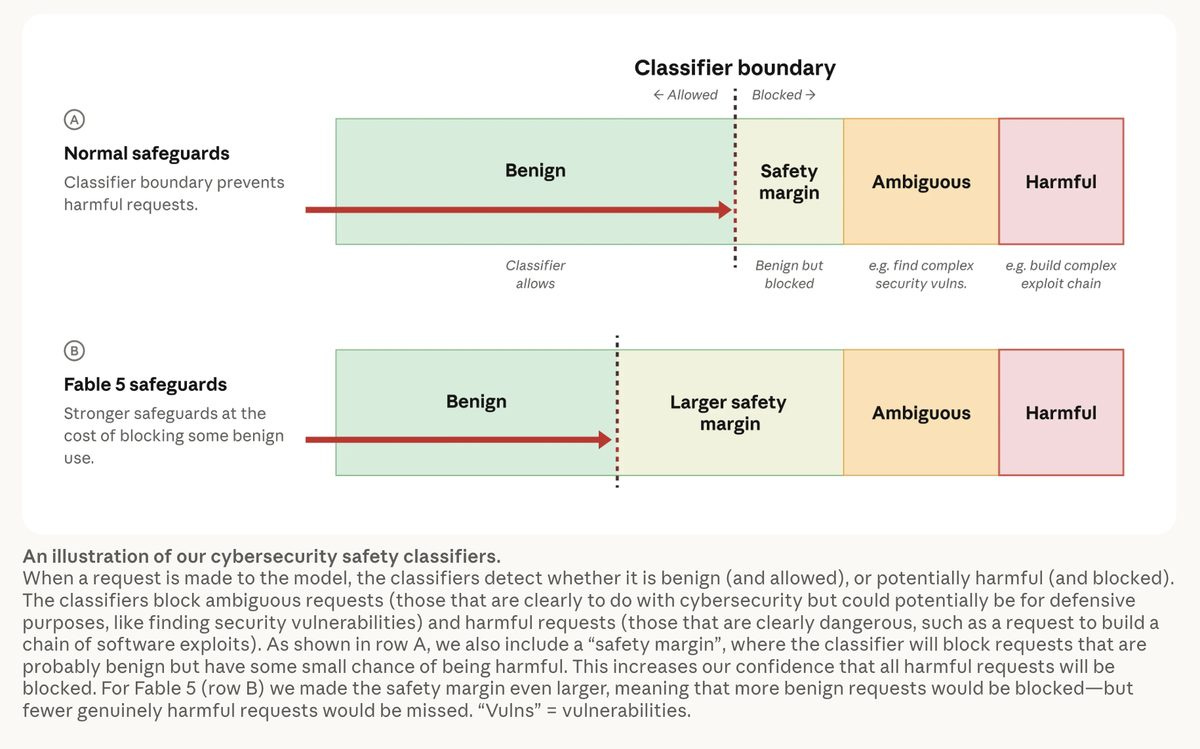
There is a band of requests Anthropic classifies as benign and blocks anyway, to buy confidence about the harmful band further right, and for Fable 5 it made that band deliberately wider: “more benign requests would be blocked, but fewer genuinely harmful requests would be missed.” A tradeoff is a fair thing to make. But a tradeoff has two sides, and only one of them is in the room when the line gets drawn. The cost of a blocked benign request is not paid by Anthropic. It is paid by the chemist, the clinician and the graduate student, who appear in that diagram as a shaded rectangle.
Nobody needs a conspiracy here, and the ASL-3 lineage argues against one. The weaker claim survives and requires no intent at all. Few organizations have ever combined frontier scientific reasoning, unilateral control over its availability, an acquired drug discovery team, a portfolio of incumbent pharmaceutical customers and internal therapeutic programs under one roof. Anthropic now holds all five. There is no published firewall between the group that sets the biology threshold and the group running the drug programs, no outside auditor, and no disclosure of where the internal work sits relative to the line that stops everyone else.
The Canary Is Not the Story

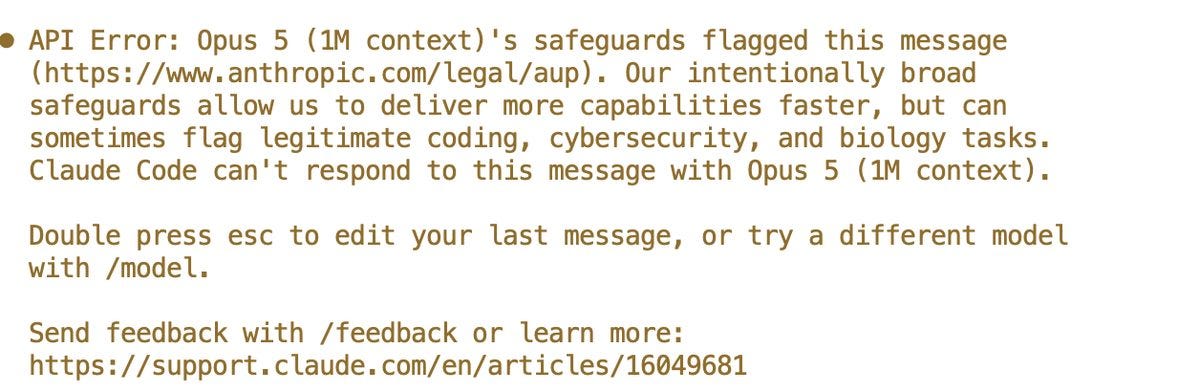
I run a drug discovery informatics company and have for 25 years. These notices appear in my terminal several times a week. The consolation used to be that a block on the top model dropped you a tier and you carried on working. That consolation is gone: the same “intentionally broad safeguards” language has arrived on the fallback tier, which advises trying a different model. Inside the workflow I selected and pay for, there is no equivalent fallback left.
That is a canary, not an argument. What makes it worth publishing is what it says about the air in the shaft. If ordinary target biology and molecular mechanism work trips the filter for someone with a Berkeley Ph.D. in biophysical chemistry, four decades in computational biology and a paid enterprise relationship, it is tripping for the graduate student, the twenty-person informatics shop and the biotech that has not raised its B round. Those organizations do not write essays about it. They quietly get less capable answers.
Anthropic has not published whether a large enterprise agreement carries the same safeguard configuration as the subscription on my laptop, and it has separately announced a trusted-access program that removes biology and chemistry safeguards for a small cohort of researchers it has not named. So I do not know whether Eli Lilly or Bristol Myers Squibb work under the same constraints I do. Neither does any other customer, competitor, or regulator. Nobody outside the company can tell. That opacity is not a side issue in this story. It is the story. And a pharmaceutical company with tens of thousands of employees has procurement leverage, legal resources and a direct line to the vendor. A graduate laboratory has none of those. Even a rule applied with perfect uniformity lands very differently depending on who you are.
Disease Is Not a Two-Company Problem
Here is my real objection, and it is not about my own access. It is about the bet.
There are more than 200 recognized types of cancer, with many molecularly distinct subtypes beneath them. What is clinically labeled Alzheimer’s encompasses substantial biological heterogeneity and frequently multiple coexisting pathologies. There are more than 10,000 recognized rare diseases, and the great majority have no FDA-approved treatment. Nothing on that list is solved by a few large pharmaceutical companies and one AI lab’s internal programs. It gets solved, if it gets solved, by an army: thousands of groups attacking thousands of targets in parallel, most of them failing, a few of them not, with the failures published so the next group does not repeat them.
Anthropic knows this. Its own life sciences lead framed the in-house programs around diseases traditional biopharma will not touch, which is a tacit admission that the field vastly exceeds any one organization’s bandwidth. That admission sits in tension with the architecture the company has built, because concentrating the most capable scientific reasoning behind a handful of incumbent pharmaceutical relationships and an in-house discovery effort is a bet that the binding constraint in medicine is capability rather than parallelism.
I think that bet is wrong, and wrong in a way that costs lives rather than money. Modern biology depends on a vast pre-competitive commons. Every molecule any of us has worked on rests on structures somebody deposited in the Protein Data Bank, sequences somebody released to GenBank, assays and dead ends somebody published anyway. You compete on the molecule, not on the fact that the protein has a pocket. A layer of intelligence that draws freely on that commons and then rations what comes back out is not a neutral instrument sitting above the field. It narrows how many shots on goal the field gets to take. And notice who sits on the unfiltered side: AbbVie, Eli Lilly, Bristol Myers Squibb, and a client list reported to include Sanofi, Novo Nordisk and Genmab. These are not the organizations most at risk of being short of capability.
Two Consolidations, Pointing the Same Way
While I was revising this essay, the other half of the picture moved. Nothing about the reported AstraZeneca and Bristol Myers Squibb talks is signed, both companies declined to confirm, and analysts were openly skeptical, so this may well not happen. But hold the reported version next to the sequence at the top. Published modeling has the merged firm leading Lilly on revenue until about 2030, which would make the two therapeutic relationships Anthropic has announced most prominently the number one and number two pharmaceutical companies in the world, with one AI vendor sitting inside both of them and running preclinical programs of its own down the hall.
That is not evidence of coordination. What it shows is direction. Capability is concentrating at the model layer and scale is concentrating at the therapeutics layer, in the same quarter, and the same short list of names appears on both sides of the table. A large share of the mechanisms that became medicines in the last forty years surfaced first in an academic laboratory or a small company. Consolidation at the therapeutics layer thins that supply. Rationing at the model layer thins the reasoning available to what remains of it. Neither trend is anybody’s crime. Together they describe a field with fewer independent shots on goal than it had in 2024, at a moment when we finally have the instruments to take more.
Call It What It Is
I have no criticism of Anthropic for wanting to win. It spent enormous capital and talent building these models, it is entitled to a return, and entering therapeutics is a legitimate commercial decision any board would consider. My objection is to the label.
When a routing policy touches the majority of an entire scientific discipline, and the company operating it has an acquired drug discovery team, several of the largest pharmaceutical companies as customers, and therapeutic programs of its own, “safety” stops being a complete description of what the mechanism does. It may still be sincere. It is no longer sufficient. A safeguard and a competitive moat can be the same mechanism, and the party operating it has no commercial incentive to hurry the disentangling.
The Question Every Other Lab Is About to Ask
Now set the ethics aside entirely and treat this as a vendor decision, which is where I have spent 25 years on the selling side of the table. Big pharma does not buy software the way a startup does. It qualifies vendors, because these systems eventually touch a regulatory filing, and four questions get asked. Can you guarantee availability. Will behavior change without notice. What is our fallback. And who else are you.
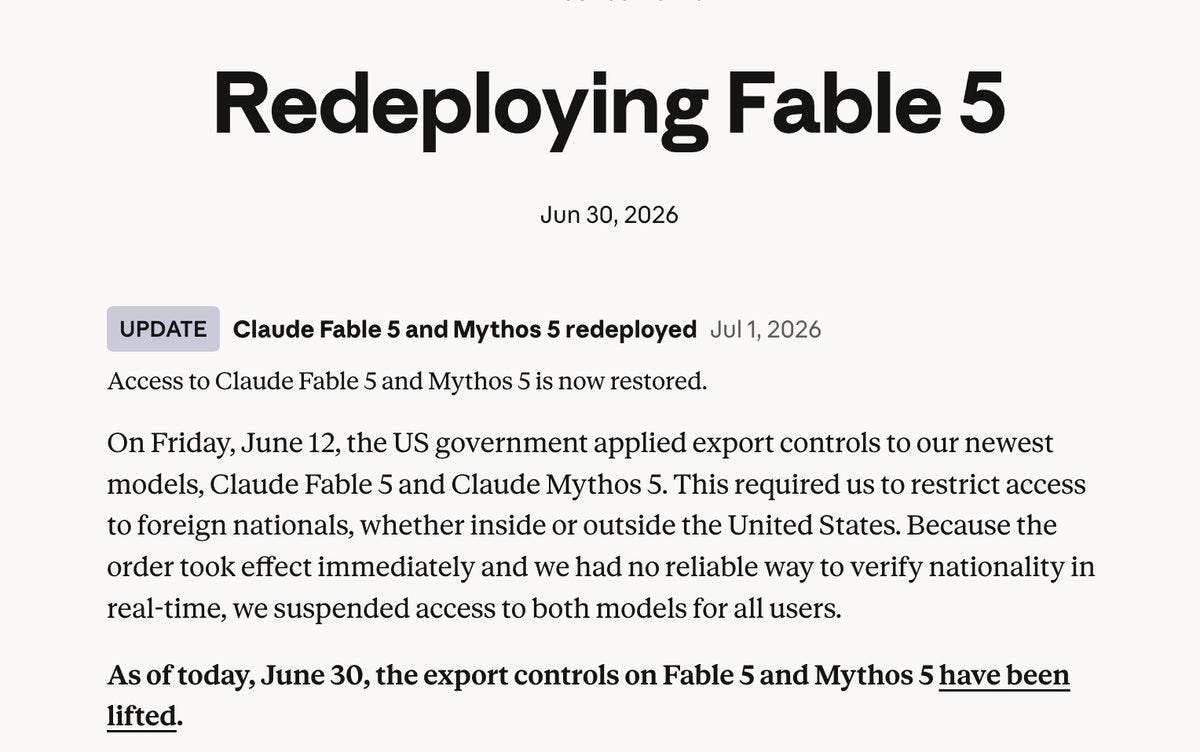
On the first three, the record of the last two months is mixed. Anthropic’s two newest frontier models went offline worldwide for roughly eighteen days in June under a US government directive concerning foreign-national access. And a classifier boundary that moves without publication, underneath a system somebody validated last quarter, is an uncontrolled change. That is not a philosophical complaint. It is an audit finding, and the remediation is revalidation.
But it is the fourth question that has changed. Your prospective platform vendor bought a drug discovery company in April, signed two of your largest competitors in April and May, and announced its own therapeutic programs in June. Nothing improper need be happening with anyone’s data, and I have no reason to think it is. But somebody in your legal department is going to write a memo containing the words our shared intelligence platform is operated by a party that has entered our industry, and that memo does not have to reach a bad conclusion to be expensive. It adds clauses. It adds review cycles. At renewal, it adds a second source.
So, honestly: do you route your target biology through that platform? Or do you build an abstraction layer, keep two providers behind it, hold an open-weight model in reserve for anything the filter is likely to touch, and never let one vendor sit alone in the critical path? I built exactly that in July, and I am not going to tear it out. Dependency is only a moat if it is reliable. Make it unreliable, or make it conflicted, and you do not get a captive customer. You get an architecture decision.
Nobody Should Be the Gatekeeper
I do not want Anthropic to lose. I want no one to win in the way that would matter. There is a version of the next five years in which one laboratory holds the most capable scientific reasoning on earth, sets the unpublished threshold that decides which questions about human disease are askable, and also owns therapeutic programs downstream of the answers. No regulator drew that boundary. No court reviews it. No affected party gets standing. The thing between us and that world is not a governance framework. It is that there are currently four credible runners in the race.
Anthropic is one. Google DeepMind is another, and through Isomorphic Labs it has integrated into drug discovery further than Anthropic has. OpenAI is the third. The fourth is the open-weight pack, and it is the one I have come to care about most, because a capability you can download cannot be rationed by anybody’s classifier. That tier used to be a consolation prize. Over the past year the gap between the best open-weight models and the closed frontier narrowed to about six points on Artificial Analysis’s intelligence index, down from thirteen, with the head-to-head Elo gap compressing from roughly 150 points to about 30. Not equal to the frontier, and I will not pretend otherwise. But close enough that a filtered request now has somewhere to go.
Which is what I would put in front of Anthropic’s own leadership, because it is not hypothetical. When the flags started landing on nearly everything substantial I do, I moved most of my daily working sessions into Codex. The work simply has to get done, and I cannot spend my afternoons rephrasing a question about a kinase until a classifier lets it through. One subscription means nothing on its own. But OpenAI is reported to have opened free access to its flagship and to Codex for 10,000 academic researchers this summer, scaling toward 100,000 through 2027, which is a company actively recruiting the exact constituency Anthropic’s biology routing turns away. Every flag on legitimate scientific work is a small, quiet transfer of a customer to a competitor, and it does not transfer back, because the abstraction layer I built in July stays built. I would rather have been kept. I am on record, repeatedly, that Anthropic’s models are the best reasoning partners I have used in forty years of this work. That is what makes the routing policy worth writing about carefully instead of quietly leaving.
Take the strongest counterargument seriously, because it is real. If you believe frontier models carry genuine biological uplift risk, then competition is not the remedy, it is the hazard, since a field’s effective caution converges on its most permissive member and open weights have no dial at all. I do not dismiss that. But the choice on offer is not between one careful gatekeeper and many careless ones. It is between rules that are published, scoped, auditable and demonstrably applied to the rule-maker’s own drug programs, and rules that are none of those things. Concentration does not make a boundary legitimate. Publication does. And a single gatekeeper has one property no amount of good faith fixes: when it is wrong, there is no appeal, and nobody outside can even tell that it was wrong. Plurality is the appeals process the field actually has. It is crude, it is accidental, and at the moment it is the only one.
Three Things to Publish
None of these removes a guardrail. All of them convert a private judgment into a legible one, and every one is in Anthropic’s own commercial interest.
One: turn the announced biology trusted-access program into a real front door. The company has said it will enroll a small number of life sciences researchers and remove the biology and chemistry safeguards for them. That is the right instinct, and it is not yet a process. Make it comparable to the Cyber Verification Program: published criteria, organizational verification, and an answer either way in about two business days.
Two: let verified identity reach the classifier. There is no anonymous user of a paid API. Every request carries an organization-scoped key, which is how the invoice gets addressed. A system that bills a customer by name and judges them as a stranger is not a safety architecture. It is an unfinished one.
Three: disclose the firewall, and publish a pre-competitive floor. State whether the internal therapeutic programs run against the same threshold as customers, and name the class of work that will not be gated: target biology, mechanism, structure, the ordinary literate content of the field. The commons these models were trained on should not be harder to reach through the model than through PubMed.
The Stakes
Nobody is going to cure Alzheimer’s inside one company. Not Anthropic, not Isomorphic, not Lilly or Bristol Myers Squibb. It will take an army, drawing on a commons, most of it failing in public so the rest can move. The question is whether the most powerful scientific instrument ever built gets pointed at that whole army, or at a few flagship accounts and an in-house research effort while everybody else is told, in the calm register of a safety notice, to try a different model. An army needs more than one armory, and it should never need permission from a company that has entered the war on its own account.
“Try a different model” is not an answer when the model being withheld is the capability the customer selected and paid to use.
References
TechCrunch, “Anthropic buys biotech startup Coefficient Bio in $400M deal,” Apr. 3, 2026
Fierce Biotech, “Anthropic acquires stealth AI startup Coefficient Bio in $400M deal,” April 2026
“Claude partners with Eli Lilly on AI-driven drug development and clinical research,” Apr. 16, 2026
Fierce Pharma, “BMS taps Anthropic’s Claude for enterprise-wide AI adoption to speed drug R&D, global workflows,” May 20, 2026
Ashley Capoot, “Anthropic launches AI drug discovery program, Claude Science,” CNBC, June 30, 2026
Anthropic Support, “Why Claude switched models in your conversation with Fable 5,” accessed July 2026
Anthropic, “Claude Fable 5 and Claude Mythos 5,” June 9, 2026
Anthropic, “Activating AI Safety Level 3 protections,” May 22, 2025
Anthropic, “Statement on the US government directive to suspend access to Fable 5 and Mythos 5,” June 12, 2026
Kyle Orland, “Anthropic says these topics are too dangerous to let its Fable 5 model talk about,” Ars Technica, June 9, 2026
“Alphabet-backed Isomorphic Labs raises $2.1B to accelerate AI-designed drug discovery as clinical trials near,” Tech Startups, May 12, 2026
Brian Buntz, “A merged AstraZeneca and BMS could lead Lilly on revenue until about 2030,” Drug Discovery Trends, Aug. 4, 2026
CNBC, “AstraZeneca in talks with Bristol Myers Squibb on $400 billion megadeal, FT reports,” Aug. 2, 2026
CNBC, “AstraZeneca slides after reports of Bristol Myers merger talks leave analysts ‘perplexed’,” Aug. 3, 2026
OpenAI, “Accelerating scientific discovery with ChatGPT for Academic Researchers,” accessed August 2026
EdTech Innovation Hub, “OpenAI offers 100,000 researchers free GPT-5.6 access,” 2026
Digital Applied, “Open-Weight Models H1 2026: DeepSeek, Qwen, Llama Recap,” accessed August 2026
Steven Muskal, “We Are Optimizing the Wrong Objective in Biology,” Renaissance Circle, Jul. 26, 2026
Structural Genomics Consortium, “Open Science,” accessed July 2026
Steven Muskal, “AI for Everyone,” Renaissance Circle, Jul. 23, 2026
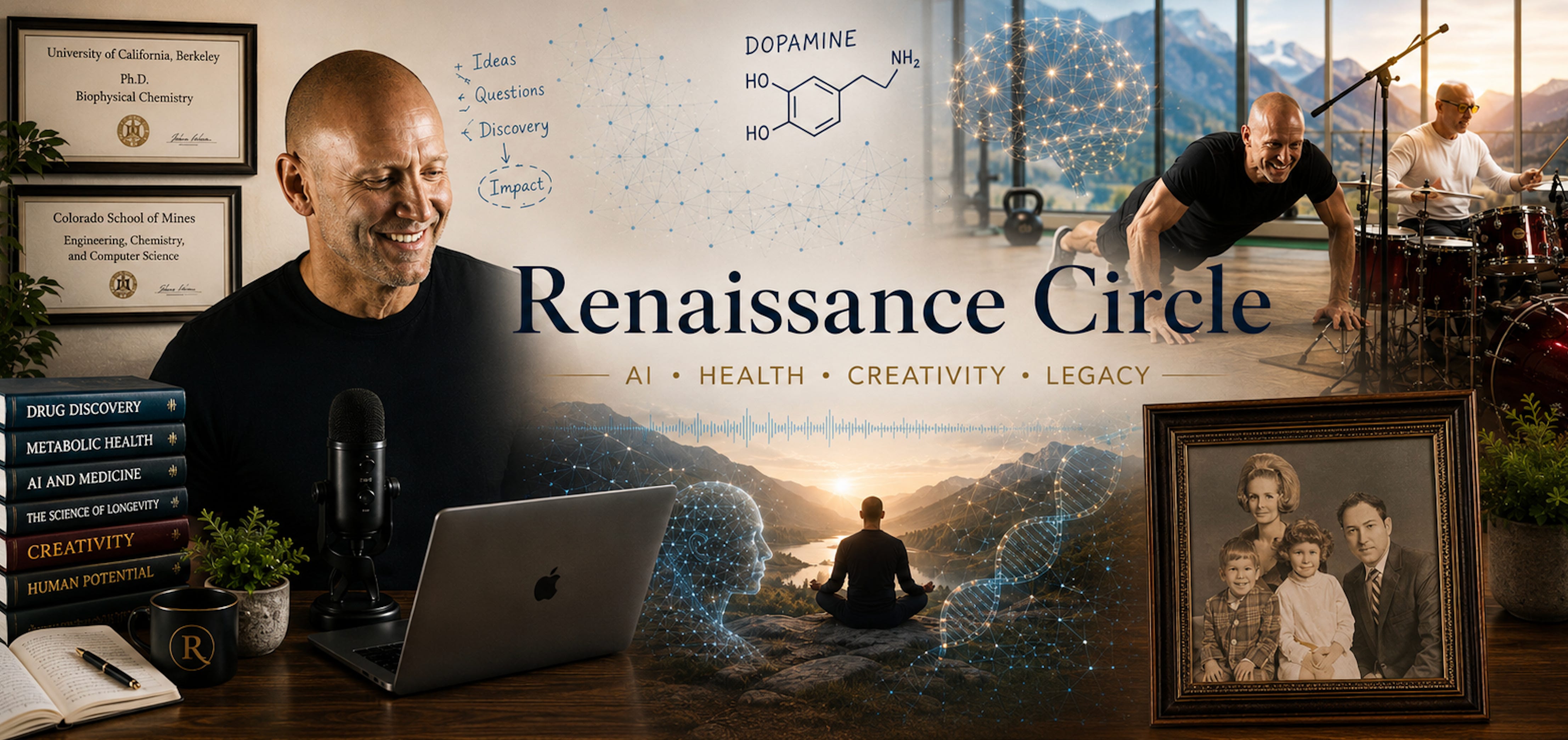
Steven Muskal, Ph.D. is the CEO of Eidogen-Sertanty, Inc. - a drug discovery informatics company. He has spent four decades working at the intersection of computational biology, AI, and drug discovery. He writes about AI, health, and the intersection of biology and technology at stevenmuskal.com