


By Steven Muskal, Ph.D. | July 23, 2026 | stevenmuskal.com
A toast to Sung-Hou Kim, and the case for putting powerful AI within everyone's reach.
In 1990, at a Gordon Research Conference, a young graduate student stood up to talk about neural networks in front of a room full of crystallographers. He was proud of the work. The reply came back flat: “That is no big deal. We knew that decades ago.” The room went quiet. The graduate student was me, and the silence felt like a door closing.
Then Sung-Hou Kim stepped in. He did not pile on. He widened the conversation, gave the idea room to breathe, and helped a beginner stand back up. I have carried that moment for thirty-five years, because it taught me something that matters more now than ever: expertise can humiliate the next generation, or it can help them keep going.
The Voice I Started to Hear in Myself
When modern AI took off, I caught myself reaching for the same dismissive sentence that once stung me. “We have been doing this for decades.” It is even partly true. It is also the least useful sentence in the room.
The problem is not whether the sentence is correct. The problem is what it does socially. It closes the door at the exact moment the room needs more people: alternative ideas, creative pressure, skeptical pressure, perspectives from outside science, and the naive question that experts have stopped asking. The old reflex is to defend the field. A better move is to widen it. The best move is to teach the tool.
“That’s no big deal” is the sentence that closes the door. “Come join the party” is the one that opens it. Same expertise, two very different rooms.
The Lab Was Already an AI Lesson
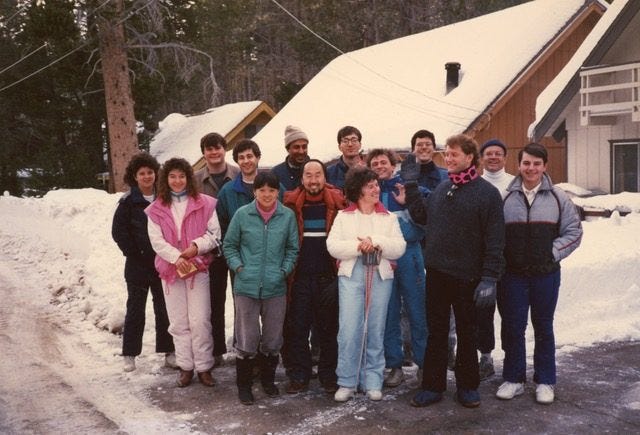
Long before any of this, Sung-Hou’s lab was already teaching the lesson. It worked because it was never one lane. It mixed crystallography, biology, chemistry, computation, and method-building, and it gathered people who were willing to collide ideas with one another. Cross the disciplines, ask better questions, build new lanes.
That is exactly what good AI does now. It helps us cross the lanes we used to stay inside. Berkeley remains an ideal of the public institution: world-class excellence paired with a real diversity of disciplines and people. The photographs here are not decoration. They are the proof. The science happened because the people did things together.
A Long Arc
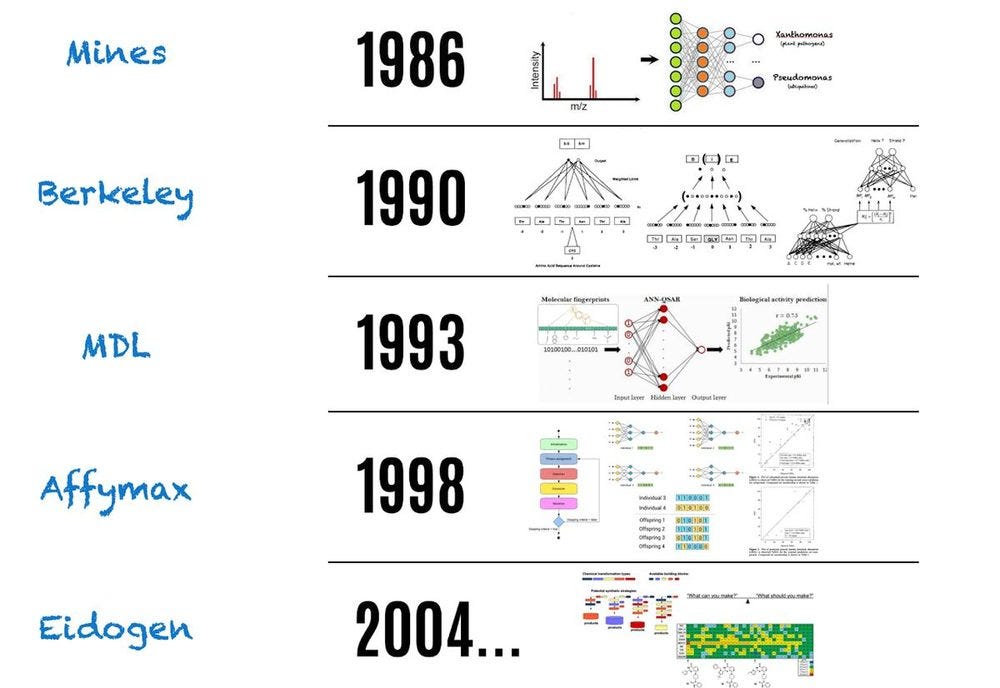
A quick word on why this moment feels different. The arc runs from neural nets in the 1980s, to Berkeley in 1990, to MDL in 1993, to Affymax in 1998, to Eidogen in 2004 and beyond. For decades we built tools with AI. The timeline itself is not the point. The point is the turn at the end of it: now AI builds the tools, and it builds them in plain English.
I Say What I Want Built. The System Builds.
This is the part that still feels like science fiction to me, except that I use it every day. I describe what I want in ordinary language, and the system builds it. Not magic, and not automatic judgment. It is a new interface: English as the front door into software, data, media, memory, and scientific workflows.
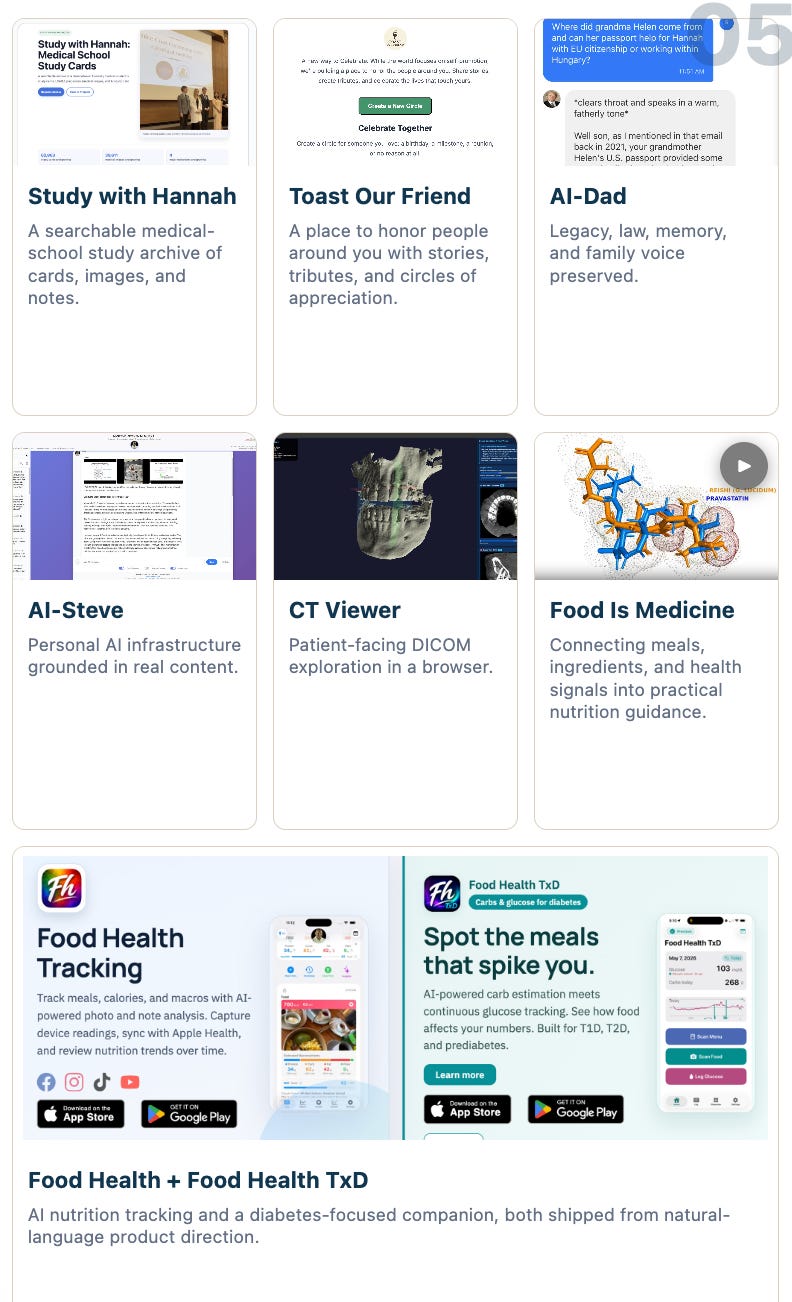
The result is a set of real things, not slideware. Toast Our Friend, a place built to honor the people around us instead of promoting ourselves. AI-Dad, which preserves legacy, memory, and a family voice. AI-Steve, a personal AI infrastructure grounded in real content. Image Explorer, which searches decades of photographs by visual similarity. A browser-based CT viewer for patients. Food Is Medicine, which connects meals, ingredients, and health signals into practical guidance. And a nutrition pair, Food Health and Food Health TxD, a diabetes-focused companion, both shipped from natural-language direction. I did not write the plumbing by hand. I said what I wanted built, and the system built it.
A Bionic Amplifier
The fear in the room is always the same: will this replace me? I think that is the wrong question. The better one is: which parts of my work should no longer consume my life?
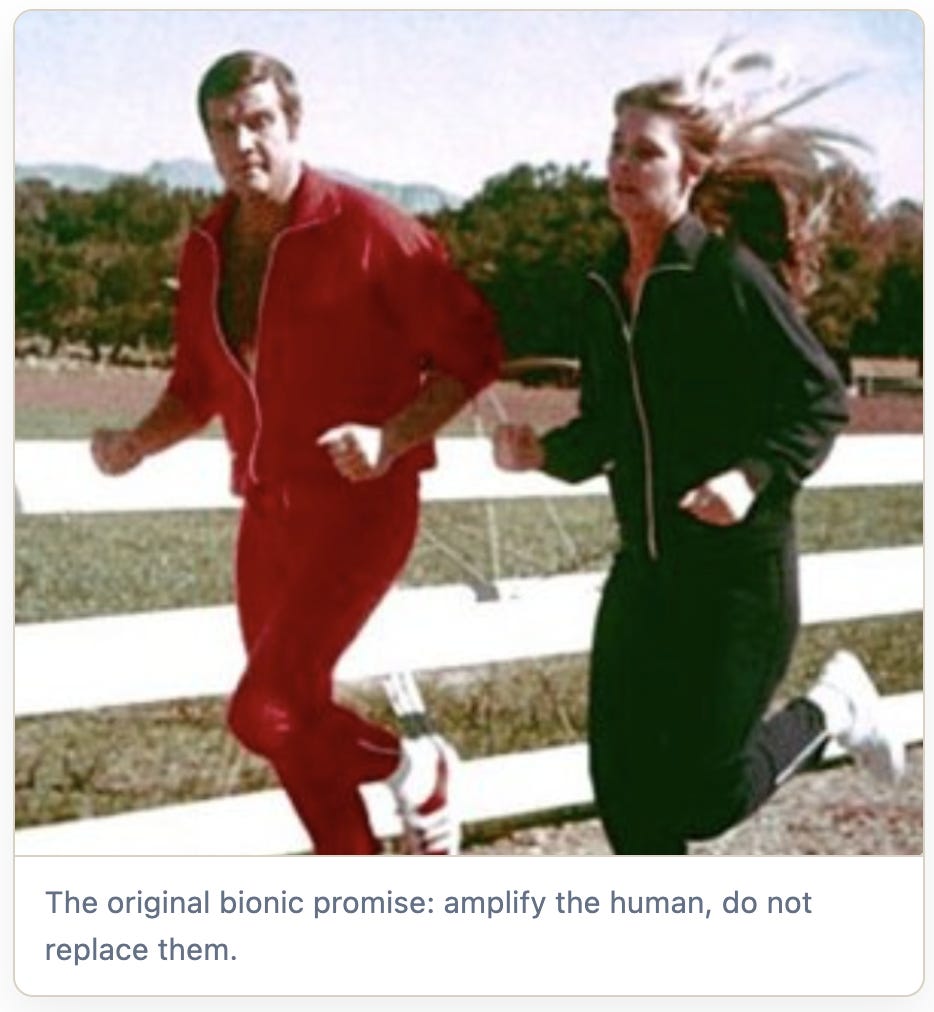
Picture a bionic arm. It does not decide what matters. It extends what a person can do. AI is the same kind of thing. It amplifies reach, speed, recall, and iteration, while the human still sets the direction and checks the consequences. Some tasks will be automated: summaries, first drafts, formatting, routine searches, data cleanup, scheduling, comparison tables. The human work stays human: priorities, ethics, taste, relationships, experimental judgment, courage, and the ability to recognize when an answer is nonsense. Time, not compute, is the scarcest resource. Spend it on judgment.
Content Makes Kings
Here is the part I care about most. Models are only ever as good as the human content beneath them. A model that memorizes looks brilliant on what it has seen and falls apart on what it has not.
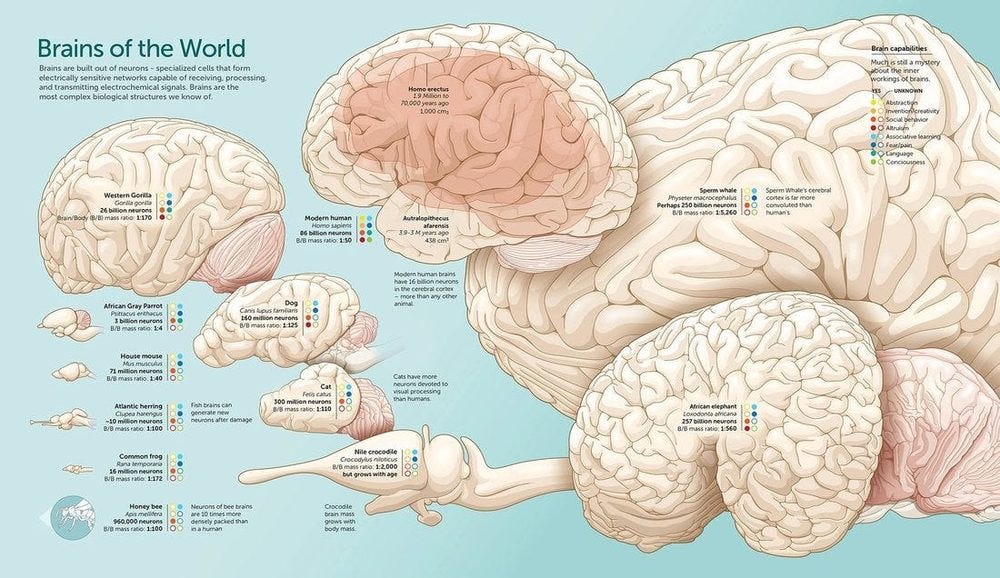
Two pictures make the case. The first is a panel of brains across species. Whales and elephants carry more neurons than we do, yet raw neural capacity never settled who leads. We carry more meaning. What we know, what we notice, what we ask, and what we care enough to preserve: that is the content that makes kings.
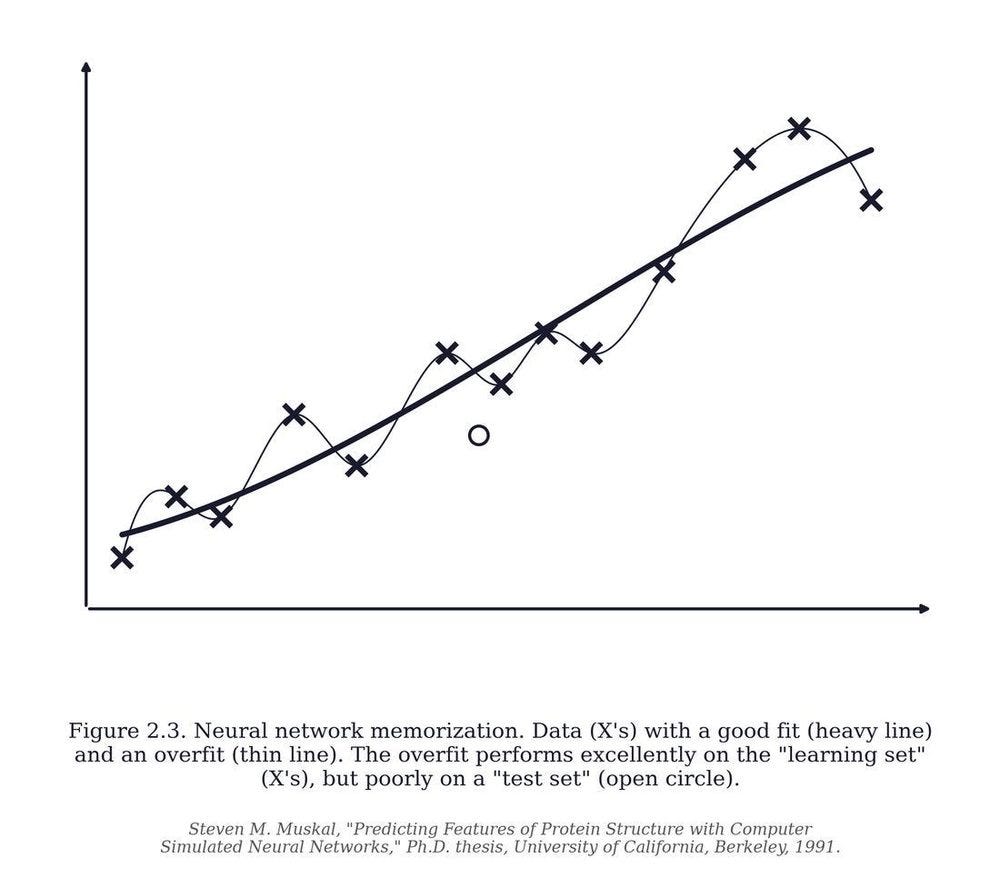
The second is a curve from my own 1991 Berkeley thesis. An overfit model nails every training point and then misses the one held-out point that mattered. Garbage in, garbage out, now running at the scale of the entire internet. Content is king. Content is currency. Content makes kings. Fresh, honest, human content is the scarce resource that keeps the whole system from collapsing in on itself. And language, the most powerful interface we have to these tools, belongs to everyone, not only to people who write code.
The Machine Is Learning to Move

Look a little further out and the machine is learning to move. A surprising share of the human cortex is devoted to the hand. Controlling it in real time is one of the hardest problems nature ever solved, and still the hardest thing to build into a robot.
Think of the hardest task in sports. A hundred-mile-per-hour pitch leaves no time to react. A great hitter predicts, pre-commits the body, and fuses that forecast to a violent, exquisitely timed swing. Prediction and execution as a single act. That is precisely what embodied AI has to crack.
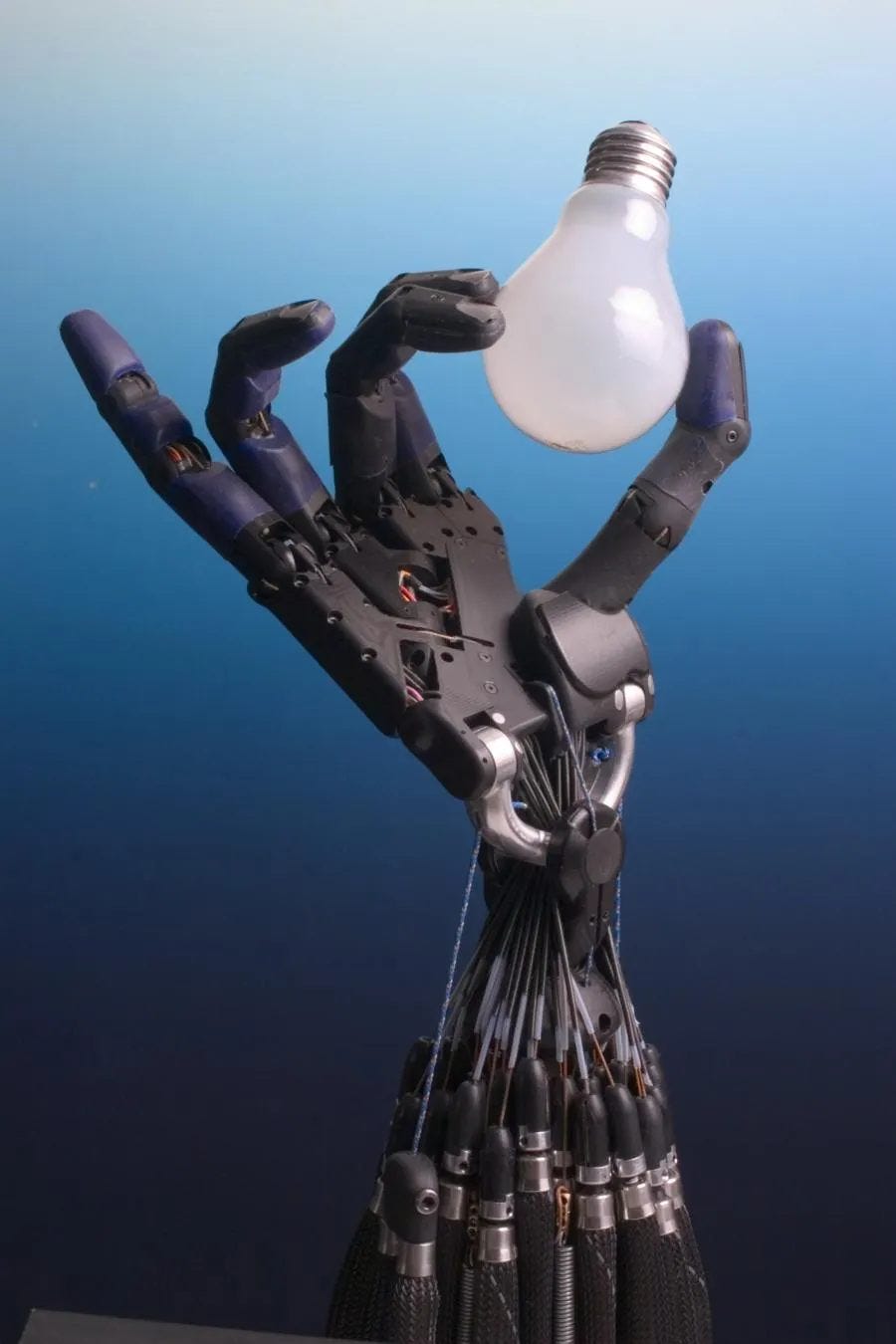
The same coupling of cognition and dexterity that made us human is now being assembled in silicon, steel, and carbon fiber. Handled wisely, with guardrails, it does not replace what we are. It extends what we can build. Automating back-breaking, health-eroding labor can be a human act, not only an economic one, if we build the vocational on-ramps and the safety nets on purpose. A choice, not a fate.
The Answer to Fire
We have lit a fire. We always do. The answer to fire was never to extinguish it. The answer was to learn how to carry it, contain it, teach it, and build hearths around it.
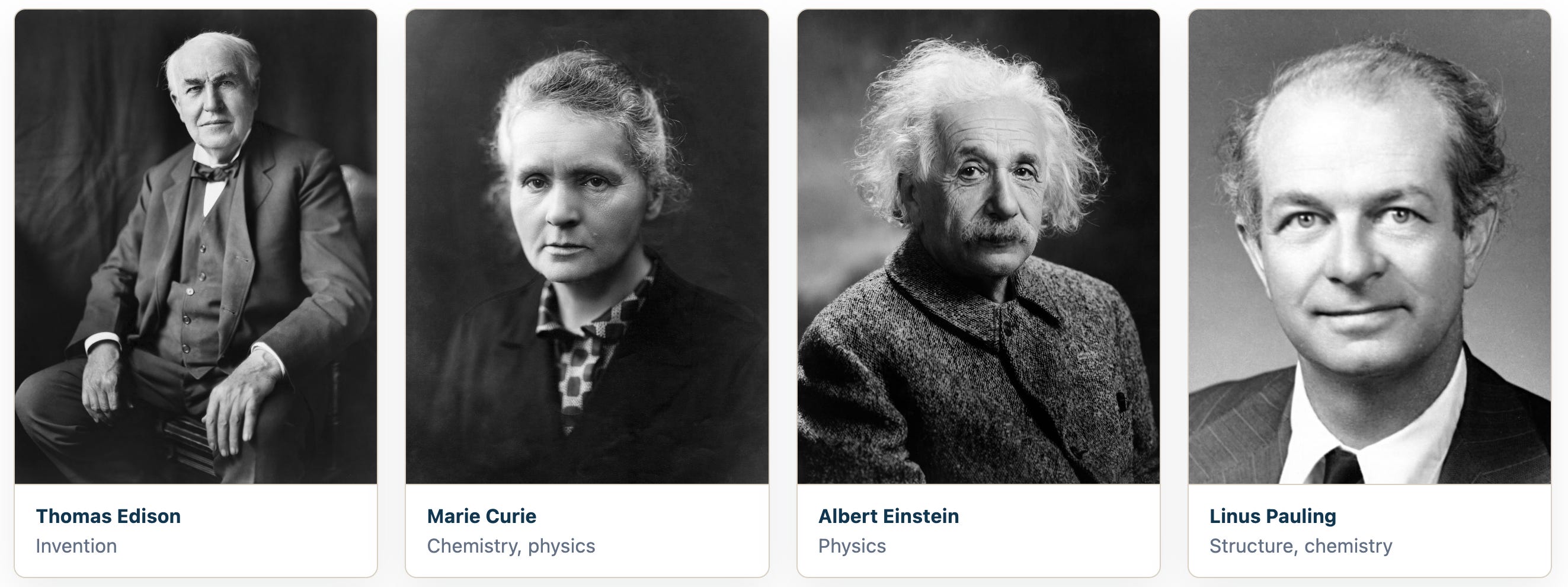
Fire warmed us, cooked our food, protected us, and transformed human life. It also burned people and leveled cities. Serious tools require serious culture. Not naive optimism, and not fear either, but responsibility paired with access. Edison, Curie, Einstein, Pauling: brilliance has always existed everywhere. What has not always existed is access to the lane where brilliance can swim. Berkeley is extraordinary, but the next remarkable person may never get near it. AI can help far more people find serious lanes of their own.

The answer to fire was to learn how to carry it.
AI for Everyone
The napkin math
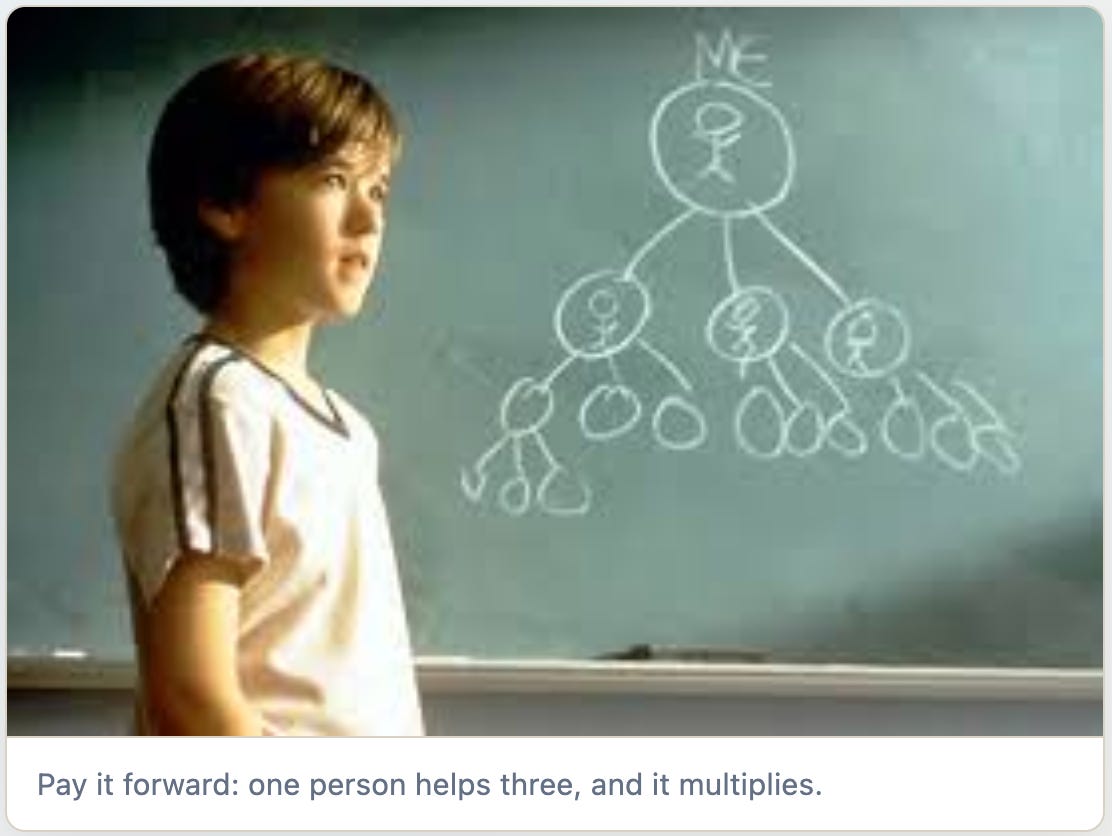
Here is some back-of-the-envelope math on why paying it forward matters. The classic version starts from a single person: if one person teaches three people, and each of them teaches three more, it takes about 21 rounds to reach everyone on Earth, and about 18 rounds to reach everyone in the United States.
But we are not starting from a single pioneer anymore. There are already at least a million people, probably a few million, building software in natural language (i.e., agentically) with tools like Claude Code and Codex. Now assume something far weaker than the classic chain letter: not everyone succeeds, and on average each of us helps just one and a half new people become builders per round while continuing to mentor others. That means the community becomes 2.5 times as large each round. Starting from one million people, that reaches every adult in America in roughly five rounds and every adult on Earth in about ten.
If that still sounds aggressive, cut the average to just half a new builder per person per round - equivalently, one new builder every two rounds. The community then becomes 1.5 times as large each round. America is still reached in roughly fourteen rounds, and the world in about twenty-two.
This is napkin math. It ignores overlap, saturation, and the friction of real adoption. But the conclusion survives any reasonable assumption: we are not decades away from a world where ordinary people program computers in plain language. We are a handful of pay-it-forwards away. So teach one person this month. Better yet, teach two, and ask them to do the same.
Where the Race Is Actually Won
While we are doing arithmetic, it is worth zooming out to the question everyone asks: what about China?
Sebastian Mallaby recently wrote a guest essay in The New York Times after a reporting trip through Beijing, Shanghai, Shenzhen, and Hangzhou. His conclusion: America’s chip export controls have failed to slow China’s AI progress. Every time a U.S. lab ships a cutting-edge model, Chinese rivals rapidly absorb its capabilities and distill them into models of their own. In his words, “the follower has the advantage.”
The news has only reinforced that point. On July 17, 2026, Chinese startup Moonshot AI unveiled Kimi K3, a 2.8-trillion-parameter open-weight model that approaches the performance of America’s frontier systems. Reuters described it as the world’s largest open-weight AI model, underscoring how quickly frontier capability is diffusing beyond the handful of companies that first create it.
I believe Mallaby is right, but I would push the argument one step further. Frontier models matter. Frontier models alone do not win. Deployment wins.
There is another reason I think this trend will continue. The internet is not infinite. Recent work by Epoch AI estimates the effective supply of publicly available, high-quality human-generated text at roughly 300 trillion tokens. As frontier models continue to scale, they are rapidly consuming that finite corpus, while an increasing fraction of new online content is itself AI-generated. The future of AI therefore depends less on learning ever more from yesterday’s internet and more on generating genuinely new human knowledge.
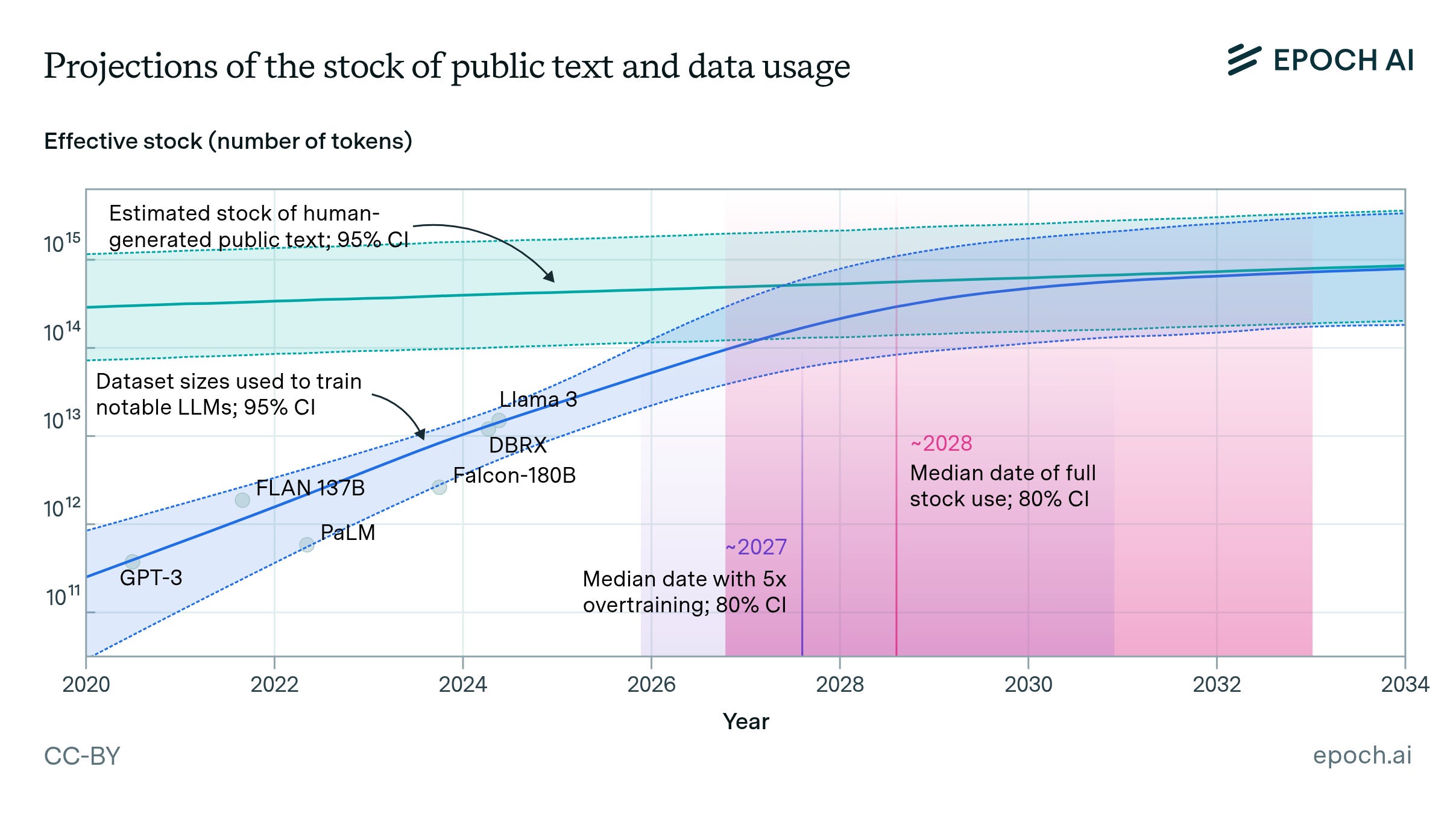
Readers may recognize the analogy to the overfitting figure shown earlier from my Berkeley thesis (Figure 2.3 above). As model capacity continues to increase while the supply of fresh human knowledge grows much more slowly, simply making models larger delivers diminishing returns. Researchers have also shown that repeatedly training on synthetic AI-generated content can reduce diversity and quality unless that data is carefully curated. The scarce resource is no longer compute. It is original human content.
That brings us back to the central theme of this essay: Content Makes Kings. Frontier capability is becoming a commodity. Once a breakthrough exists, it spreads astonishingly quickly through open-weight releases, distillation, competitive engineering, and independent innovation. No nation or company builds a lasting advantage on an asset that depreciates that fast. Durable advantage comes from continuously creating new knowledge and turning it into useful applications.
Mallaby arrives at the same conclusion: “the accelerating power of the leading models won’t determine who wins the A.I. race. It’s A.I. deployment that will matter.” Raw capability has to be transformed into products, businesses, institutions, and everyday tools. If frontier intelligence becomes broadly available - and every month suggests it will - the contest shifts to who can convert it into useful software the fastest.
That is exactly where the near-term opportunity sits: application development and solopreneurship. A single person with deep domain expertise can now stand up a real product in days rather than quarters because agentic tools handle much of the engineering that previously required an entire team. The frontier is no longer defined solely by who builds the smartest model, but by who turns intelligence into the most useful applications.
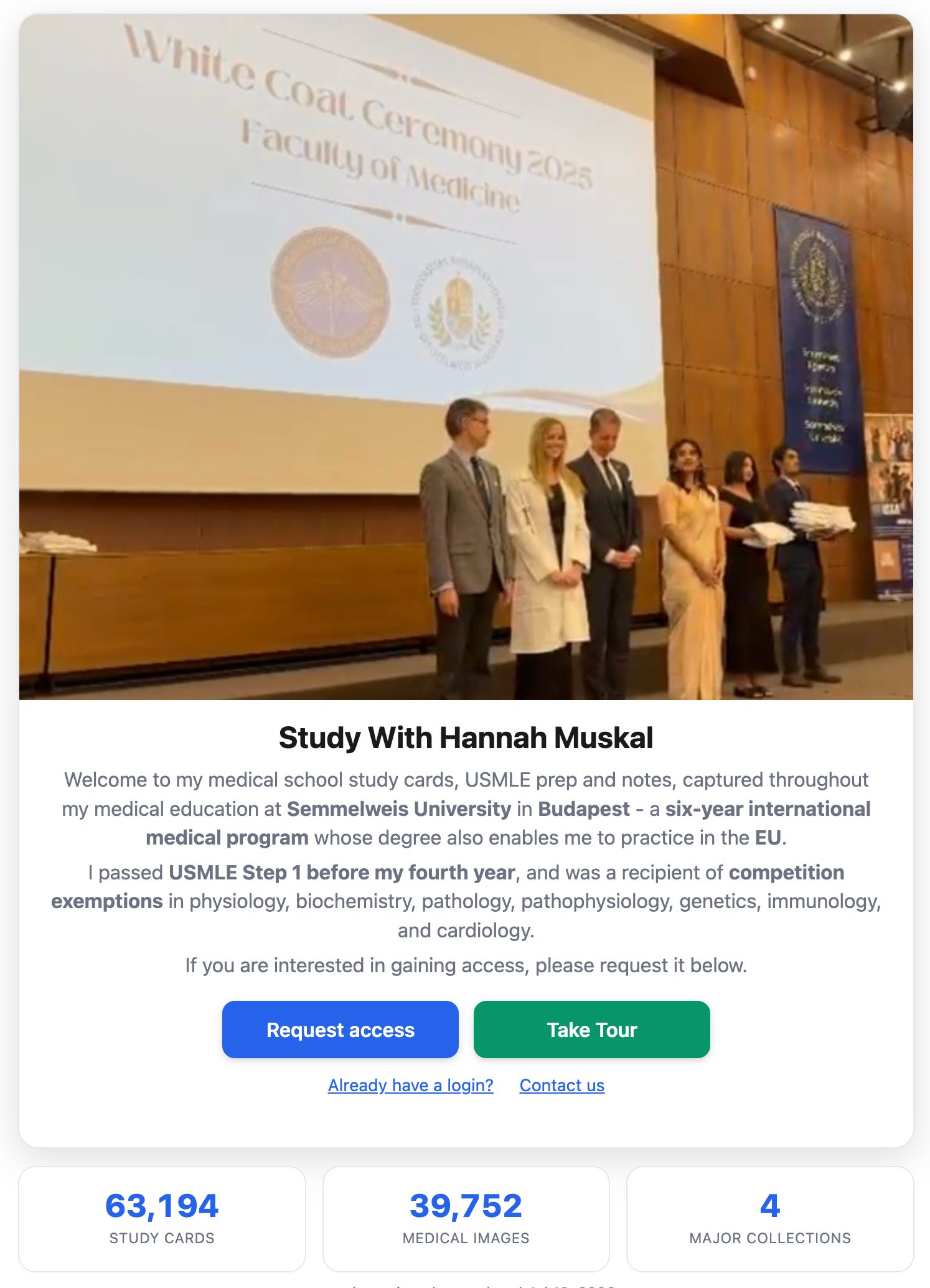
A concrete example. Hannah spent four years of medical school building a study repository: tens of thousands of flashcards, nearly forty thousand medical images, and organized notes spanning every course and board exam. Working together with agentic coding tools, we turned that repository into Study with Hannah, a searchable archive with visual image search, an AI tutor that cites the specific cards behind each answer, and a spaced-repetition drill system. The core system was built in a few hours. A subscription business was live in under a day. Content that took years of disciplined work to create became a deployed product between breakfast and dinner.
Multiply that by every nurse, teacher, contractor, and shop owner who learns to build this way, and the pay-it-forward math above stops being a parlor trick. Countries will not win the deployment race with a handful of frontier labs. They will win it with millions of people who can turn what they know into working software. Teaching the person next to you is not charity. It is industrial policy from the bottom up.
Measure it, monetize it
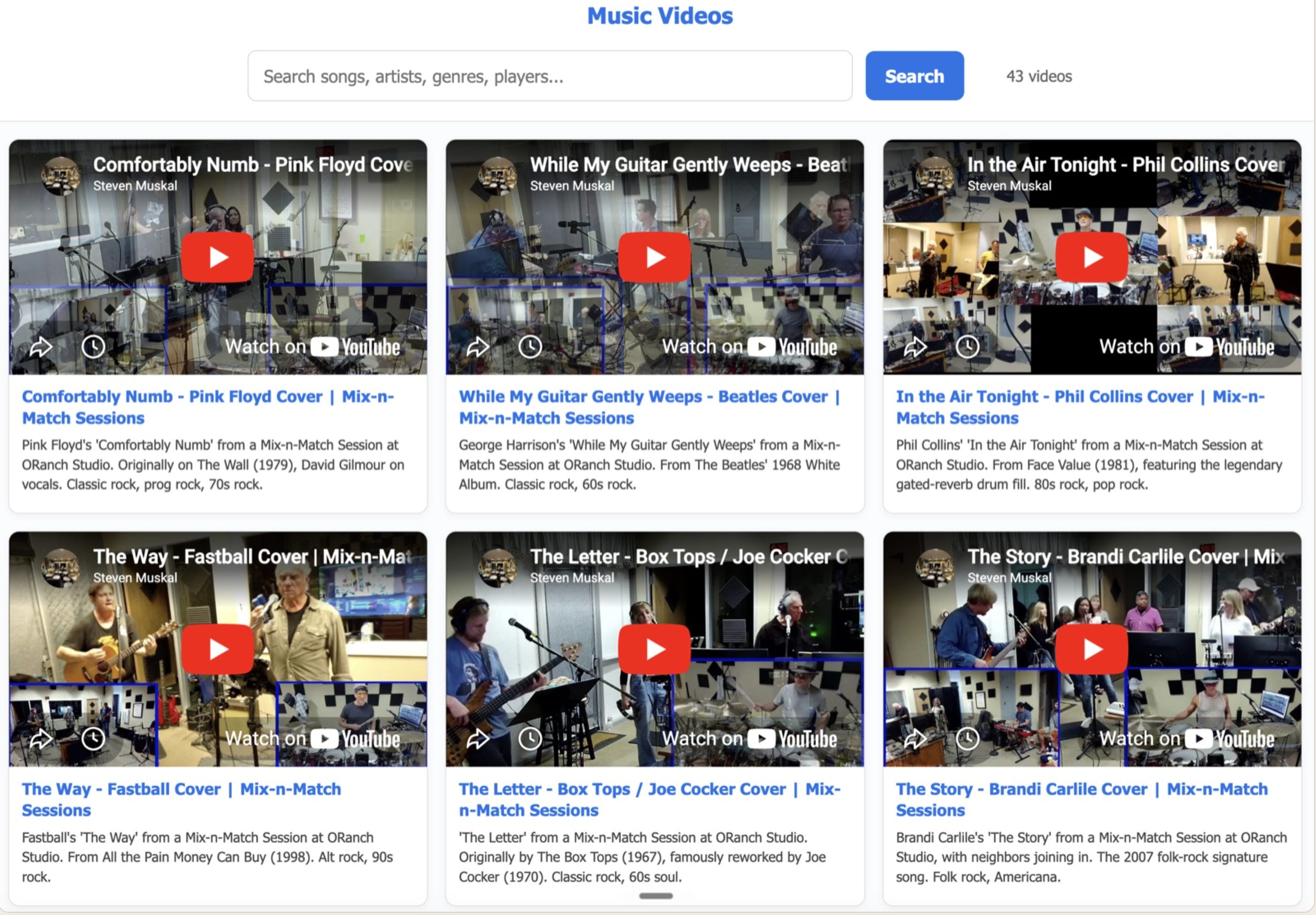
There is a broader principle hiding in that story. I used to tell teams, “If you can measure it, you can manage it.” For anyone with an entrepreneurial itch, I would now update it: if you can measure something, you can monetize it. Every log you keep, every collection you curate, every process you track produces something other people need, and agentic tools have collapsed the cost of wrapping a real product around it. Glucose readings become a nutrition companion. Study cards become a tutoring service. Session recordings become a searchable library.
The measurement was always the hard part. The business around it used to take a team and a year; now it takes a person and a weekend. So look at what you already measure in your work or your life. Somewhere in it is a subscription, a service, or a tool that someone will pay for.
So I Want to Close Where I Began
At that silent room, and the person who refused to let it stay silent. For those of us who have been in the AI game for years, and for those who arrived last week, the work is the same: pass the tool, not the intimidation.
Use It. Pick one task this week that wastes your time, and let AI help you move through it.
Share It. Sit with one person who is curious or fearful, and let them drive. Translate. Don’t lecture.
Preserve It. Capture the stories, the expertise, the images, the notes, and the methods. Original human content is the fuel that keeps the next generation of AI grounded in reality.
Build It. Look at what you already know, measure, or create. Somewhere inside it is a product, a service, or a business waiting to exist. The cost of building has collapsed. The limiting factor is no longer software engineering. It is the courage to begin.
At that Gordon Research Conference, Sung-Hou modeled how an expert can rescue a beginner instead of crushing him. That was the AI moment in miniature, long before the phrase meant anything. He did not simply defend an idea. He opened a door.
We now have the chance to do the same for millions of other people.
We get to choose which voice we become: the one that says, “That’s no big deal,” or the one that says, “Come join the party.”
The fire is already lit. Build something with it. Teach someone with it. Leave it burning brighter than you found it.
Postscript
The Innovator’s Dilemma Comes for the University
After a recent conversation with Sung-Hou Kim, I want to add one more thread, because it follows directly from “pass the tool, not the intimidation.” If individuals can pass the tool, so can institutions. The open question is whether they will.
We talked about Berkeley, and about higher education in general, through the lens of the innovator’s dilemma. That dilemma is usually told about big companies: a successful incumbent hesitates to embrace a disruptive approach because the new thing threatens the brand and the revenue that the old thing still produces. I think the same trap now sits in front of universities. Many are quietly fearful of new models, not because the models are weak, but because they might cannibalize the very thing that funds the institution.
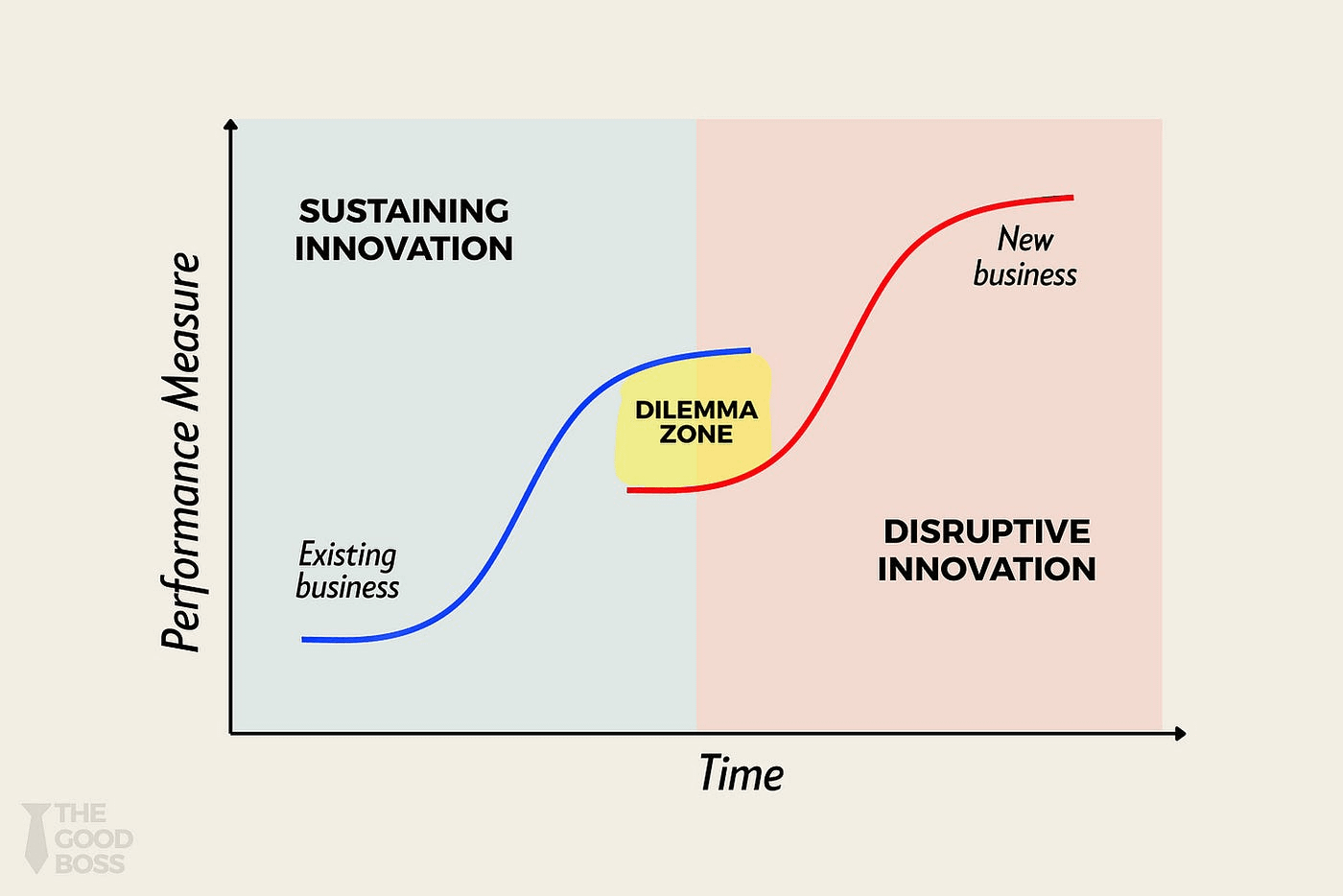
We have seen a version of this before, with online education. Some universities held back. Others leaned in. Harvard and MIT built edX; Stanford faculty helped seed Coursera; lectures that once lived in one room became available to people anywhere in the world. The schools that embraced it discovered that access and brand are not enemies. They widened their reach, opened subscription and online-degree revenue, and lost none of their prestige. If anything, they gained.
AI raises both the stakes and the opportunity. Every serious university sits on decades of published research, course material, library collections, and the working knowledge of its faculty, postdocs, scientists, and staff. Imagine each institution building a university-specific large language model, trained and grounded on that corpus. Not a static archive of recorded lectures, but a living system you can interrogate: ask a question, follow up, push back, and learn in dialogue with the accumulated knowledge of the place. Offer it as subscription-based access, and you extend the university’s mission to anyone in the world with curiosity and a connection, without diluting the degree or the brand.
Institutions like Berkeley have an extraordinary opportunity to expand their global impact by transforming decades of published research, educational content, and faculty expertise into AI-accessible knowledge systems, rather than simply protecting the traditional model.

Berkeley, of all places, should recognize this moment. This is a campus that has carried civilization-scale fire before. In Room 307 of Gilman Hall, Seaborg and his colleagues identified plutonium in 1941; Ernest Lawrence’s cyclotron sat just up the hill; and J. Robert Oppenheimer, a Berkeley physics professor, convened the 1942 summer conference here that became the theoretical seed of Los Alamos. The roots of the nuclear age run straight through this campus. Berkeley learned, in the hardest way there is, what it means to carry a powerful fire responsibly. It is exactly the kind of institution that could lead the pack in carrying the next one.
The framing I keep returning to is not about protecting the old model. It is about expanding the mission: turning published research, educational content, and faculty expertise into AI-accessible knowledge systems that reach far beyond the lecture hall. That is the opposite of cannibalization. It is multiplication.
This thread deserves a fuller piece on universities in the AI era posted in June - Universities Built the Bomb. Now Build This. Consider this the seed. The same question that now faces each of us soon faces the institution: not whether to carry the fire, but whether to share it.
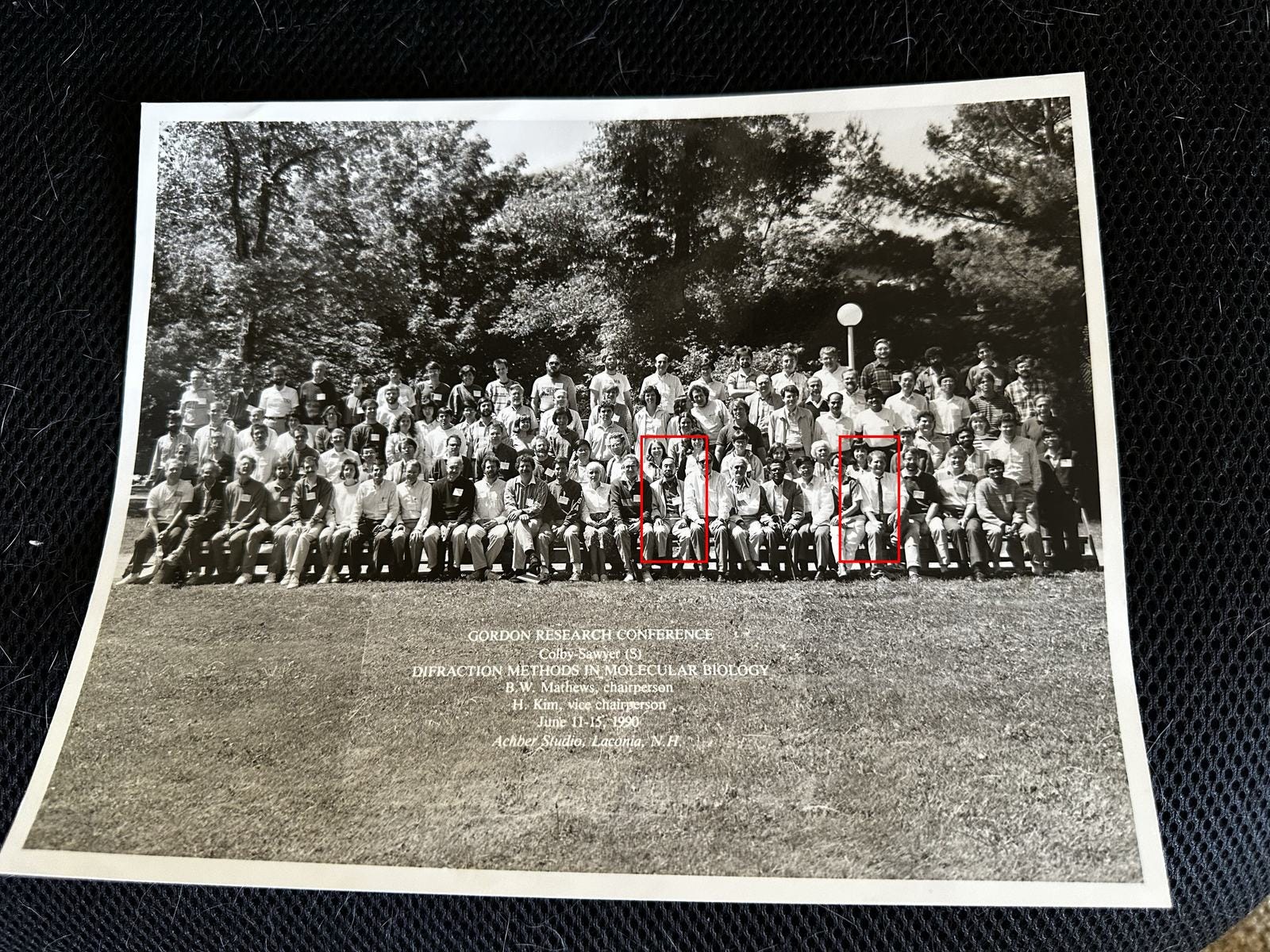
Bringing s photo to life:
HOW IT WAS MADE (technical recipe for reproducibility):
Model: Runway Gen-4 Turbo (image-to-video), via the Runway developer API.
- Model: gen4_turbo, ratio: 1280:720, duration: 5-10s
- Image sent as base64 data URI
- Cost: ~25 credits (~$0.25) per 5s clip
Pipeline:
1. Start from the cleanest, highest-resolution source image (rotated upright)
2. Run runway_animate.py (below) with a carefully crafted stand-up prompt
3. Clip the output with ffmpeg to the clean window (before quality degrades)
#!/usr/bin/env python3
"""Single, careful Runway Gen-4 Turbo image-to-video run.

Submits ONE image_to_video task (5s), polls, downloads the result. Designed to
spend the minimum: one completed gen4_turbo 5s clip ~= 25 credits (~$0.25).
"""
import os, sys, time, base64, requests
from pathlib import Path
from dotenv import load_dotenv

WORKSPACE = Path(__file__).parent
ENV = Path("XXXXX.env")
load_dotenv(ENV, override=True)

API = "https://api.dev.runwayml.com/v1"
VERSION = "2024-11-06"
KEY = os.environ.get("RUNWAY_API_KEY", "").strip()

IMAGE = WORKSPACE / "attachments" / "gordon_v2.png"   # upright, higher-quality source
OUT = WORKSPACE / "gordon_runway_v2.mp4"
MODEL = "gen4_turbo"          # ~5 credits/sec
DURATION = 5                  # 5s: less time to drift into turning their backs
RATIO = "1280:720"

PROMPT = (
    "The people in this group photograph come to life. Everyone who is seated stands "
    "up onto their feet to a normal standing position, joining those already "
    "standing, so the whole group ends up standing. As they stand they keep their "
    "feet flat on the ground and stand normally; no one extends, kicks, lifts, "
    "raises, or stretches out their legs. Once standing, everyone keeps facing toward "
    "the camera and only turns their head and shoulders slightly to the left and "
    "right to talk and smile with the people next to them. No one turns around, no "
    "one shows their back to the camera, no one walks away, leans far over, or bends "
    "down; they all stay facing generally forward, interacting in place. Everyone has "
    "natural, realistic human proportions and normal height, not stretched or too "
    "tall, and everyone stays sharp and in focus with no blurring, smearing, or "
    "melting. The camera stays steady and wide, keeping the whole group in frame, no "
    "strong zoom. Natural, realistic, documentary look."
)

def main():
    if not KEY:
        print("ERROR: RUNWAY_API_KEY not set"); return 1
    if not IMAGE.exists():
        print(f"ERROR: image not found: {IMAGE}"); return 1

    b64 = base64.b64encode(IMAGE.read_bytes()).decode()
    data_uri = f"data:image/png;base64,{b64}"
    headers = {
        "Authorization": f"Bearer {KEY}",
        "X-Runway-Version": VERSION,
        "Content-Type": "application/json",
    }
    body = {
        "promptImage": data_uri,
        "promptText": PROMPT,
        "model": MODEL,
        "ratio": RATIO,
        "duration": DURATION,
    }
    print(f"Submitting {MODEL} {DURATION}s (ratio {RATIO}) ...")
    r = requests.post(f"{API}/image_to_video", headers=headers, json=body, timeout=60)
    if r.status_code >= 300:
        print(f"SUBMIT FAILED [{r.status_code}]: {r.text[:500]}")
        return 1
    task_id = r.json().get("id")
    print(f"task id: {task_id}")
    if not task_id:
        print("No task id:", r.text[:300]); return 1

    deadline = time.time() + 420
    n = 0
    while time.time() < deadline:
        n += 1
        time.sleep(10)
        pr = requests.get(f"{API}/tasks/{task_id}", headers=headers, timeout=30)
        if pr.status_code >= 300:
            print(f"poll error [{pr.status_code}]: {pr.text[:300]}"); continue
        d = pr.json()
        st = d.get("status")
        print(f"[{n:02d}] status: {st}")
        if st == "SUCCEEDED":
            out = d.get("output") or []
            url = out[0] if isinstance(out, list) and out else (out if isinstance(out, str) else None)
            if not url:
                print("SUCCEEDED but no output url:", str(d)[:400]); return 1
            print(f"downloading: {url[:90]}...")
            v = requests.get(url, timeout=120); v.raise_for_status()
            OUT.write_bytes(v.content)
            print(f"SAVED {OUT.name} ({OUT.stat().st_size/1_048_576:.1f} MB)")
            return 0
        if st in ("FAILED", "CANCELED"):
            print("TASK", st, "-", str(d.get("failure") or d)[:400]); return 1
    print("timed out"); return 1

if __name__ == "__main__":
    sys.exit(main())
Further reading
This essay accompanies a short talk, AI for All. Watch it at the top, or at
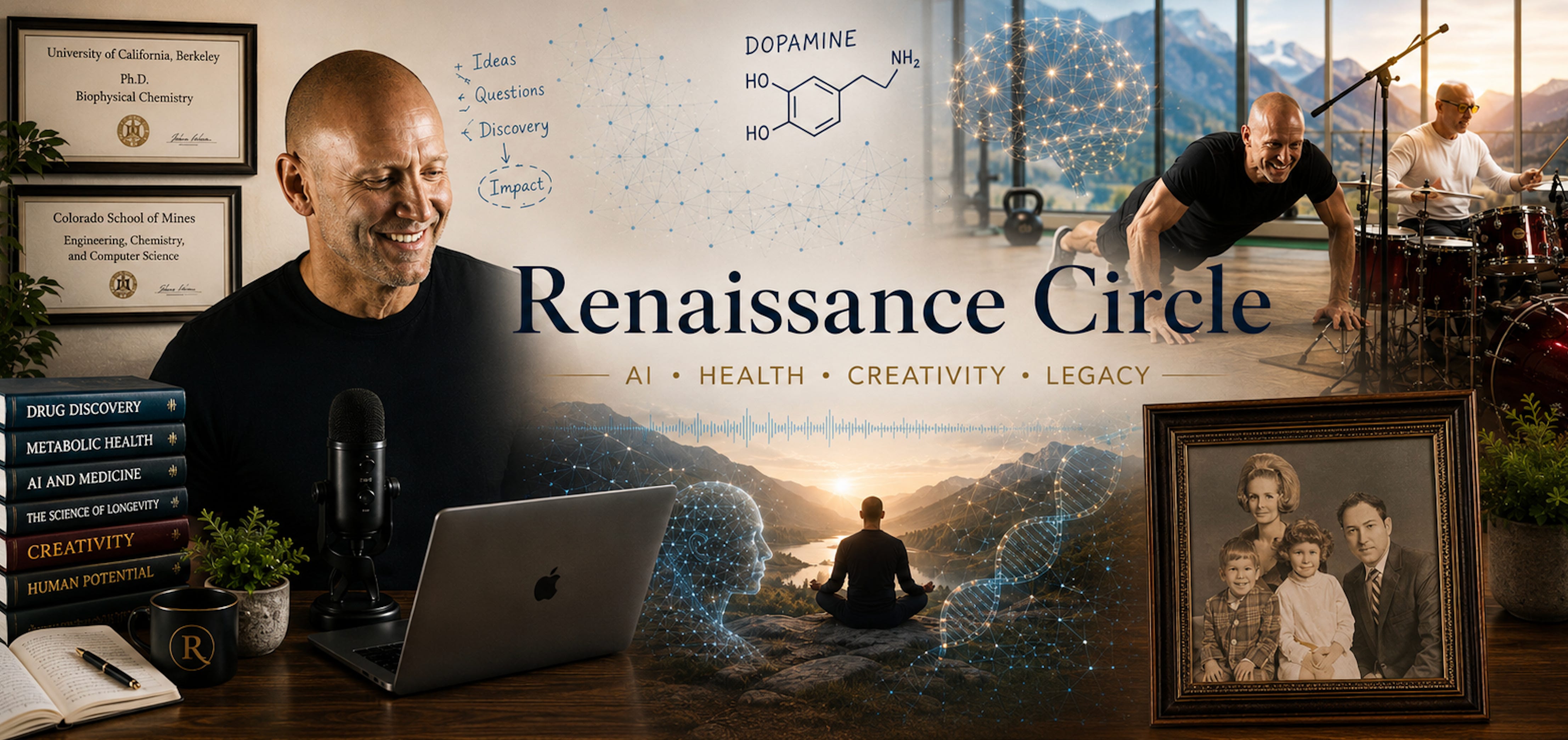
Steven Muskal, Ph.D. is the CEO of Eidogen-Sertanty, Inc. - a drug discovery informatics company. He has spent four decades working at the intersection of computational biology, AI, and drug discovery. He writes about AI, health, and the intersection of biology and technology at stevenmuskal.com


