



Curiosity Is the Only Sustainable Edge
Every so often, a conversation reminds me that technology is never the real story. People are.
Tools change. Platforms rise and fall. Paradigms come and go. But beneath all of that, it’s always human behavior, motivation, and perception doing the real work.
This week, I spent time talking with Moritz “Moe” Koeppenkastrop-Lueker, and what stood out wasn’t any single role he’s held or company he’s worked at. It was the coherence of his path once you strip away titles and timelines. From the outside, his journey might look nonlinear, even scattered. From the inside, it’s remarkably consistent.
It’s driven by a single constant: curiosity.
And in this moment, curiosity may be the only edge that actually compounds.
From Gelato to Gravity
Moe’s first exposure to entrepreneurship didn’t come from venture capital, accelerators, or pitch decks. It came from gelato.
His family ran a gelato business in Hawaii, starting as a small, hands-on operation and eventually growing into a company with multiple locations and dozens of employees. As a teenager, Moe wasn’t learning “startup theory.” He was learning how to talk to customers, how to persuade restaurant owners, how operations really work when margins are thin and expectations are high.
That kind of learning leaves a mark.
Early exposure to real constraints shapes how people think. When you grow up watching something being built from scratch, you internalize that businesses are not abstractions. They’re living systems made of people, timing, tradeoffs, energy, and persistence. You learn that progress rarely looks clean. You learn that success often comes from responding well to small problems, day after day.
Those lessons don’t fade when the context changes. They scale.
From there, curiosity took Moe elsewhere. Mechanical engineering in Miami. Graduate work in medical device engineering in Germany. Travel across India and Southeast Asia. Each step wasn’t about optimizing a résumé or following a predetermined path. It was about seeing how different systems work, technically and culturally.
That pattern never stopped. It simply changed form.
Nonlinear Paths and the Illusion of Optimization
We often talk about “nonlinear careers” as if they’re risky deviations from a safer norm. In reality, they’re often the most internally coherent paths available to curious people.
Linear paths optimize for predictability. Nonlinear paths optimize for learning.
Moe’s trajectory makes sense precisely because he kept choosing environments that expanded his understanding of how the world actually works. Different industries. Different countries. Different incentive structures. Different kinds of failure.
Over time, this produces something far more valuable than specialization alone.
It produces judgment.
Judgment is the ability to make good decisions in unfamiliar situations. To recognize patterns without forcing analogies. To know when to push, when to pause, and when to walk away entirely.
Judgment doesn’t come from credentials. It comes from curiosity sustained over time.
Venture Capital as a Classroom
After grad school, Moe entered venture capital. Not as a destination, but as an education.
VC offers a rare vantage point. You see dozens, sometimes hundreds, of companies up close. You observe founders in moments of confidence and moments of doubt. You watch teams wrestle with hiring, positioning, fundraising, product focus, and timing.
You learn quickly that ideas are abundant and execution is rare.
More importantly, you see how little correlation there often is between brilliance and outcomes. Some smart teams fail. Some average teams succeed. Timing, distribution, and feedback loops matter more than polish.
This exposure reshapes how you think about progress. You stop romanticizing ideas and start respecting iteration. You realize that clarity beats cleverness. You learn that momentum is fragile and must be earned repeatedly.
Over time, Moe felt the pull away from being a generalist observer and toward being closer to the work itself. Watching from the sidelines is instructive, but it doesn’t satisfy a builder’s instinct forever. He wanted skin in the game. He wanted faster feedback. He wanted to feel the consequences of decisions directly.
That pull brought him back into operating roles at startups, including a Y Combinator–backed company, and eventually to Tara Connect, a Google X spinout working on wireless optical communications. Fiber-level bandwidth delivered by laser beams through air. Serious physics. Real constraints. Moonshot origins.
Again, the throughline wasn’t prestige. It was proximity to learning.
Proximity to Feedback Changes How You Think
One of the most underappreciated factors in growth is proximity to feedback.
When you’re close to the work, reality pushes back immediately. Assumptions get tested. Hypotheses fail fast. You don’t get to hide behind abstractions or narratives for long.
This is where modern tools fundamentally change the landscape.
AI collapses the distance between idea and artifact. What once required teams, budgets, and months of coordination can now happen in hours or days. The loop between curiosity and action tightens dramatically.
This doesn’t mean everything becomes easy. It means different things become hard.
The challenge shifts from how to build to what to build.
When Tools Collapse Roles
Where our conversation really deepened was around AI, not as a product category, but as a force multiplier.
Moe was an early user of large language models, back when they were rough, slow, and often wrong. What interested him wasn’t polish or novelty. It was leverage. The ability to compress time between an idea and something tangible.
This is the shift many people still underestimate.
AI doesn’t eliminate expertise. It amplifies judgment. It rewards people who can decide what to build, why to build it, and when to stop. The bottleneck is no longer implementation. The bottleneck is discernment.
We talked about how roles that once required teams can now be handled by individuals with the right mental models. Research. Prototyping. Analysis. Writing. Even basic engineering.
The result isn’t fewer ideas. It’s faster iteration.
And faster iteration changes everything.
The Real Emergence of the Solopreneur
The idea of the solopreneur has existed for decades. What’s new is that it’s now structurally viable at scale.
Not lifestyle businesses. Not side hustles. Real products. Real distribution. Real impact.
One person, a small constellation of collaborators, and AI agents handling much of the rest. The constraint is no longer headcount. It’s clarity.
This doesn’t mean teams disappear. It means teams form differently. More fluidly. More intentionally. Expertise becomes something you pull in when needed, not something you carry permanently.
For the first time, curiosity and execution speed may matter more than institutional backing.
That’s a quiet but profound shift.
Education, Shortcuts, and What Still Matters
We also spent time talking about education and the next generation.
AI makes shortcuts unavoidable. Essays can be written instantly. Code can be generated on demand. The temptation to skip fundamentals is real.
But here’s the paradox: the people who benefit most from these tools are the ones who understand what’s happening under the hood, even imperfectly. You don’t need to be a specialist. You do need intuition.
Curiosity is what builds that intuition. The desire to ask why something works. The patience to debug. The willingness to fail publicly and keep going.
Formal education still matters, especially socially. But its monopoly on learning is gone. The advantage now goes to people who can teach themselves, synthesize across disciplines, and apply ideas in unfamiliar contexts.
That’s not a credential. It’s a habit.
Health, Friction, and Slowed Innovation
With his background in medical engineering, Moe also brought a clear-eyed view of healthcare innovation. Not from cynicism, but from experience.
The problem isn’t lack of ideas. It’s friction.
Regulation, certification, and long approval cycles discourage builders who thrive on rapid iteration. Many capable people simply choose other domains where feedback loops are shorter and progress feels tangible.
Safety matters. But speed matters too.
When feedback loops stretch into years, curiosity leaves. And when curiosity leaves, innovation follows.
We touched on an alternative direction: shifting some power back to individuals. Better data. Better feedback. Tools that make health proactive rather than reactive. Not replacing clinicians, but augmenting individuals. My Drug to Table project is one of those “open source” approaches to help change the conversation:
Once again, the theme returns. Tools are not enough. Curiosity drives adoption.
Building Without Permission
What ultimately tied the conversation together was a shared belief that we’re living through a rare moment.
The cost of building has collapsed.
The cost of experimenting has collapsed.
The cost of learning has collapsed.
What hasn’t collapsed is the need to choose.
For most of modern history, building required permission. Institutional permission. Financial permission. Technical permission. Organizational permission. Even social permission.
That world is fading.
Today, someone can wake up with an idea, prototype it by lunch, test it by dinner, and ship it globally before the day is over. Not as an exception, but as a new baseline.
Building without permission doesn’t mean recklessness. It means removing unnecessary intermediaries between curiosity and action. It means collapsing the loop between wondering and doing.
Curiosity becomes executable.
A Renaissance Worth Leaning Into
Careers will change. Roles will blur. Institutions will lag.
Some people will cling to disappearing advantages. Others will quietly adapt.
Curiosity compounds.
It compounds across disciplines. Across decades. Across technologies we haven’t met yet. It turns hobbies into skills. Skills into systems. Systems into leverage.
In a world where execution is increasingly cheap and permission increasingly irrelevant, curiosity may be the only edge that doesn’t get arbitraged away.
And that’s a Renaissance worth leaning into.
P.S. If you are curious - this is my coding setup - stand-up desk, walking treadmill, and Wispr (voice to text).

This is the AI/Steve response when prompted what to talk about. We touched on some of these things:

This is one of the images from the Apple Health integration into AI/Steve that was discussed and demo’d:

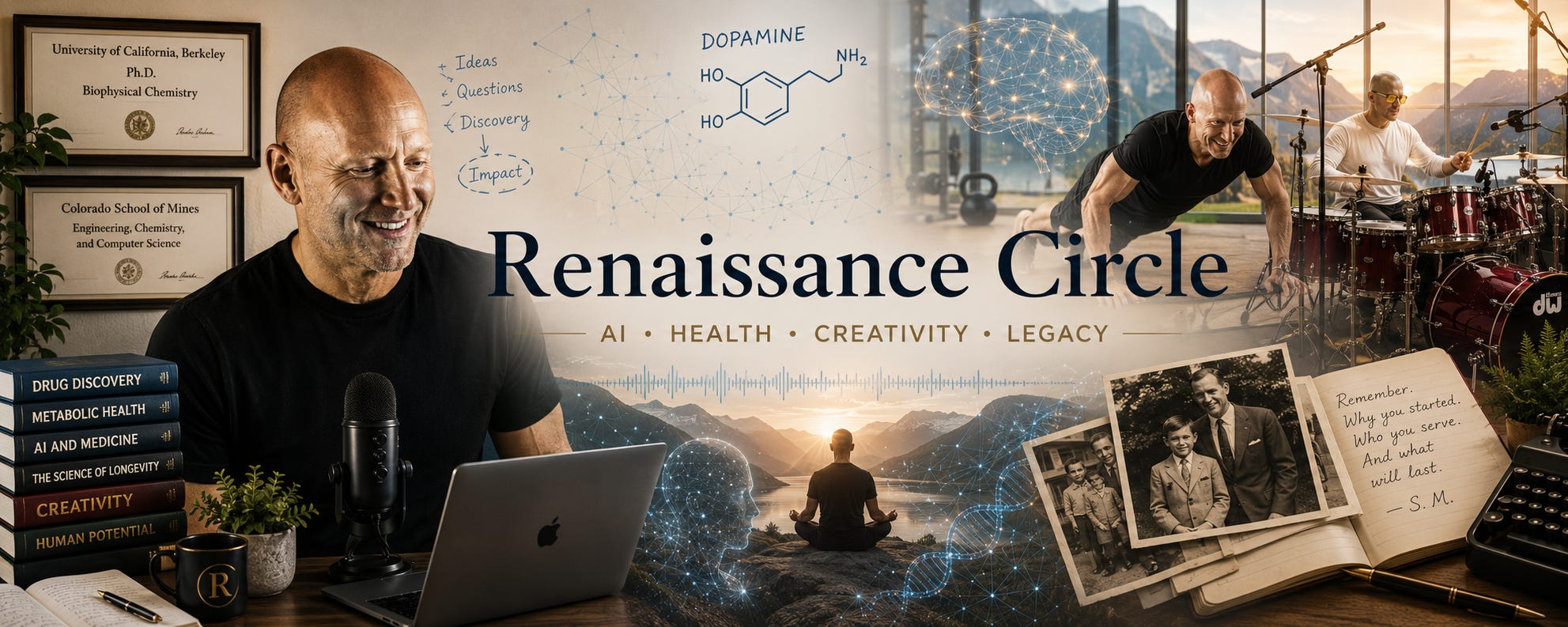
Steven Muskal, Ph.D. is the CEO of Eidogen-Sertanty, Inc. — a drug discovery informatics company. He has spent four decades working at the intersection of computational biology, AI, and drug discovery. He writes about AI, health, and the intersection of biology and technology at stevenmuskal.com
For a few mix clips - below are a few from my recent 59th B-day mix a few weeks back. Tammy, Maya, Grant knock out my favorite song Beast Of Burden. It's pretty incredible what three great singers can do with one of my favorite songs. All had fun with Crazy Thing Called Love. Other players include Rick vocals, Dom Guitar, Alan Bass and Alex on Sax.


