


The models are good enough. The next gains come from orchestrating them, and running a trained model costs pennies on the dollar compared to training one. AI looks like every software cycle before it: expensive to build once, nearly free to copy and run, and destined to move from giant central machines onto hardware people own.
Privacy will pull serious workloads out of hyperscale clouds and into local, in-house deployment. The trillion-dollar data center buildout is largely a capital-raising story sold to retail investors. NVIDIA’s slide is structural, and its CEO’s exit only gave the press a better headline. Agents will set off an explosion of small businesses that later get rolled up, and the business model will keep cycling between perpetual license, software as a service and in-house, as it always has.
On November 12, 2026, Jensen Huang resigned as CEO of NVIDIA. The headlines will tell you this was about an affair, a federal investigation, a board that ran out of patience. They’re right about the facts. If you think that’s the story, you’ve missed the story.
NVIDIA didn’t lose $1.7 trillion in market value last month because of Jensen Huang’s personal life. That selloff (a 32% slide over twenty-four trading days) started weeks before the scandal broke, on scrutiny over “circular funding” in AI infrastructure deals and mounting doubts about whether hyperscaler capex will ever generate the returns it’s pricing in. By the time Huang walked out the door, the stock was already trading at 12.9 times forward earnings, below the S&P 500 average. The market had started pricing in the correction before it had a scandal to blame it on. The resignation is a symptom. I want to talk about the disease.
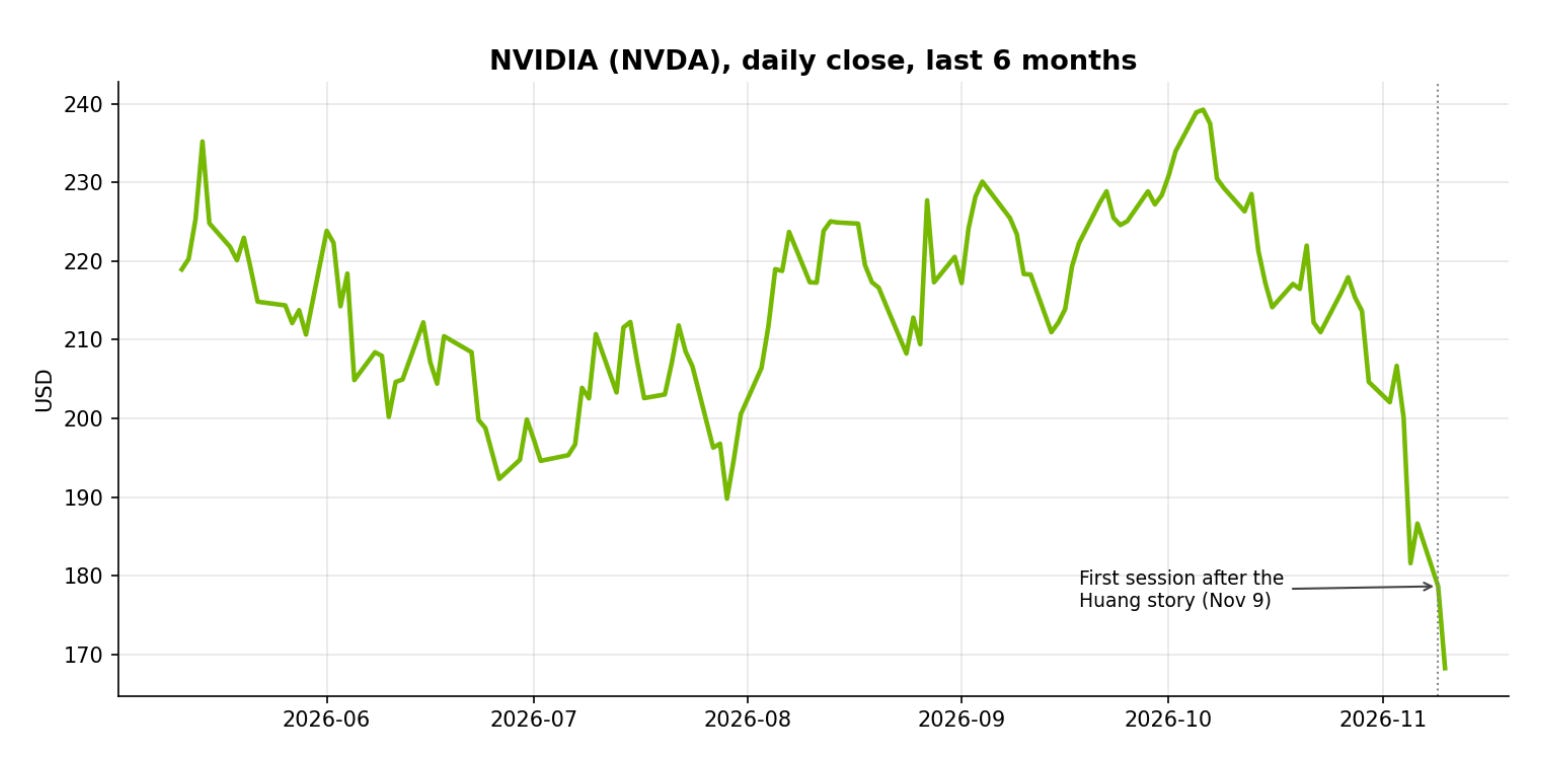
NVIDIA’s slide from its early October high was well underway before the Huang story broke. Daily close, last six months.
I called the setup “The Moat Is a Puddle” a few months back: the AI buildout is financing training at the exact moment the real constraint moved to inference and proprietary content. This piece sharpens that into a market call. The data center narrative (trillions of dollars, exponential buildout, an arms race that never ends) is a distraction. It is not where the value is, and it is not where the money is actually going to go. NVIDIA’s collapse is structural, and it has further to run. And the frontier labs themselves know it, which is why they are quietly moving on to the next trillion-dollar story: your medical records.
Forty years of watching “bigger” win, until it didn’t
I’ve been working with neural networks for over forty years. My PhD thesis used them for early protein structure prediction, a problem people are still working on today, with vastly more data and vastly more hype. Back then I had a few hundred protein structures to work with, total. I ran my models on purchased Cray supercomputer time and on high-end Silicon Graphics workstations, the direct ancestors of the GPU. Over the following decades I built and ran in-house compute clusters, server rooms full of racks, for a drug discovery informatics company I still run twenty-five years later.
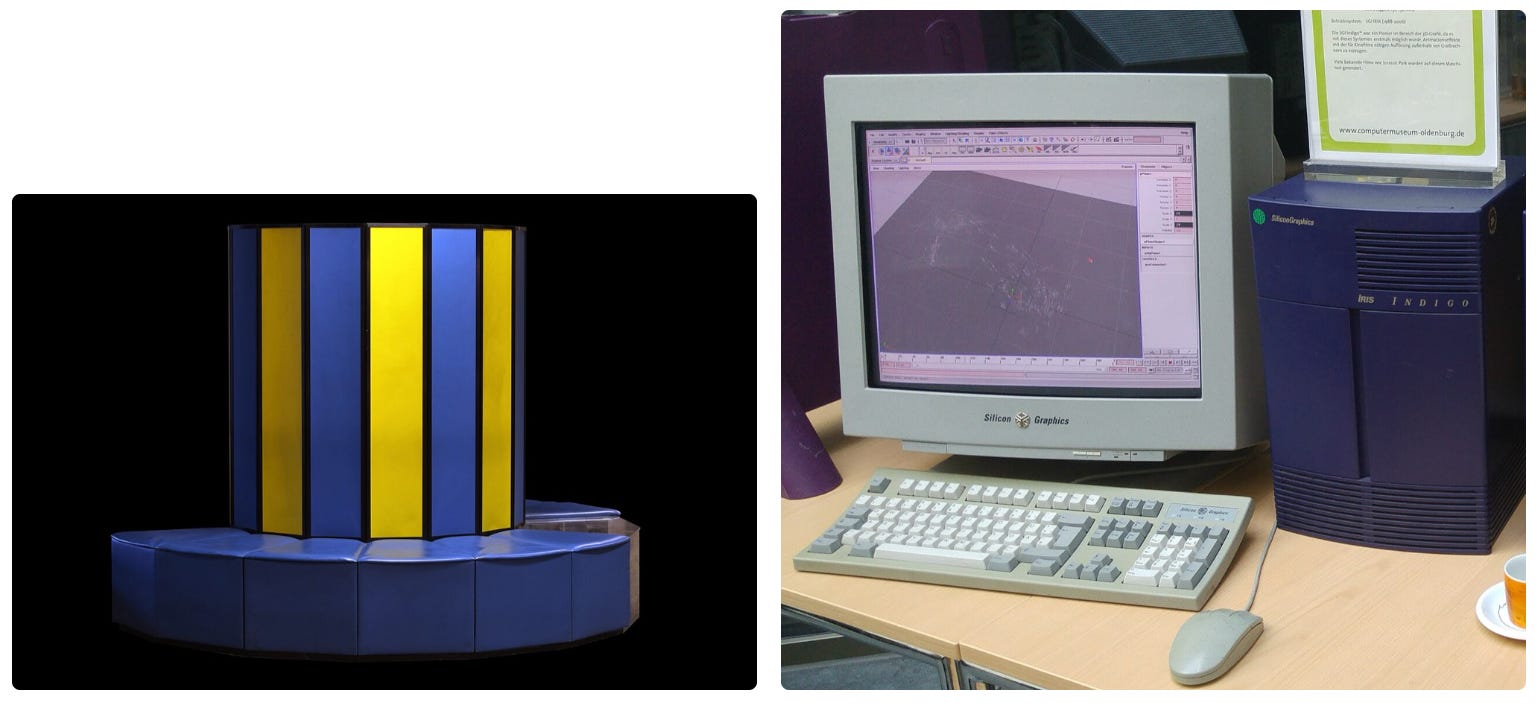
The GPU’s ancestors. Left: a Cray X-MP, the class of machine whose time I bought by the hour. Right: a Silicon Graphics Indigo workstation. Photos: Rama, CC BY-SA 2.0 FR; Wolfgang Stief, CC0. Wikimedia Commons.
I tell you this because I’ve lived through several cycles of “we need more compute” being the right call, and I recognize what it looks like when that call stops being right. We are in that second moment now. Neural network computing has been astonishingly productive. I’m one of the people who helped build it. The models we have today are good enough, and making them bigger is no longer where the next unlock comes from. The next unlock is agent orchestration: gluing models together, cycling them against each other, running them close to the metal, chaining them against live data. That is a software and systems engineering problem. It does not require another data center.
Inference is pennies on the dollar, and almost nobody outside this industry understands that
Here’s the sentence I most want you to walk away with: training a model and running a model are two different economic activities, and conflating them is the single biggest misunderstanding driving the current market narrative.
Training a frontier model is genuinely expensive: massive parallel compute, months of cluster time, enormous power draw. That’s the number everyone quotes, and it’s the number that justifies, in people’s minds, a data center on every corner. Once a model is trained, running it (inference, a forward pass against new input) costs a tiny fraction of that. You are not retraining the model every time someone asks it a question. You are evaluating a fixed set of weights against new data, and that operation is cheap, fast, and gets cheaper every quarter as hardware and quantization techniques improve.
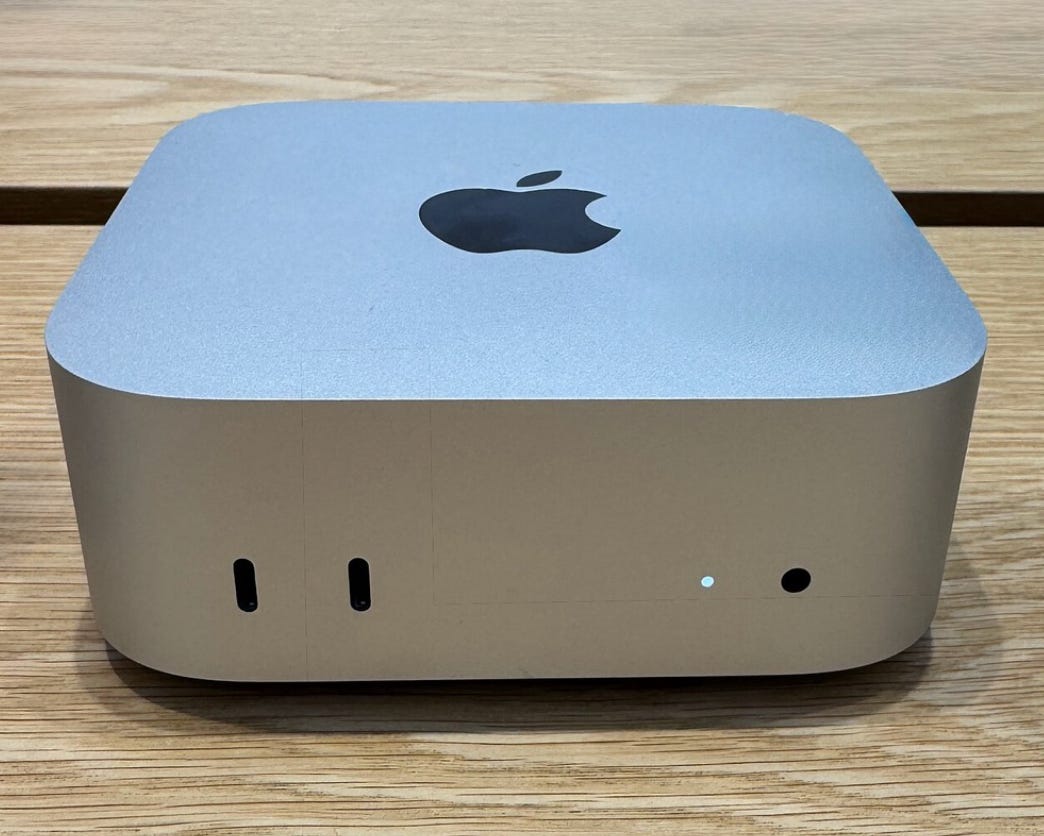
This is exactly the economics of the software business, and anyone who has run a software company understands it instantly. You spend a fortune building the product once. Then you ship copies of it at pennies apiece, and that’s where the margin comes from. A trained AI model is no different. The expensive part already happened. The weights for some of the best models on earth now fit on a thumb drive, and they will run on an Apple Mac Mini, on AMD silicon, on hardware that costs a rounding error compared to a training cluster. The chip makers other than NVIDIA (AMD and others) are going to matter a great deal more over the next few years precisely because inference is the workload most of the world actually needs to run.
Think about it the way you’d think about a trained professional. A doctor, a lawyer, an engineer spends years and real money getting educated. Once trained, they don’t go back to school every time they do their job. They turn the crank, year after year, at a cost that has nothing to do with the cost of their original training. That’s a model after training, too. The training cost is sunk. The operating cost is what matters going forward, and it is radically lower.
If you remember nothing else from this piece: the trillion-dollar capex narrative is being justified with training-era math applied to an inference-era workload. Once you see it, you can’t unsee it in every hyperscaler earnings call you read.
We have watched this movie before, with software
Software started out running on iron. In the 1960s and 70s it lived on mainframes and minicomputers in glass-walled rooms, and people reached it through dumb terminals: a screen and a keyboard on a wire, with no computing of their own. Then the software was rewritten to run closer to the user. First on workstations, then on personal computers, then desktops, laptops, and eventually a phone in your pocket. Every step moved the computing out of the central machine and onto hardware the user owned, and every step made the central machine look less inevitable than it had the year before.
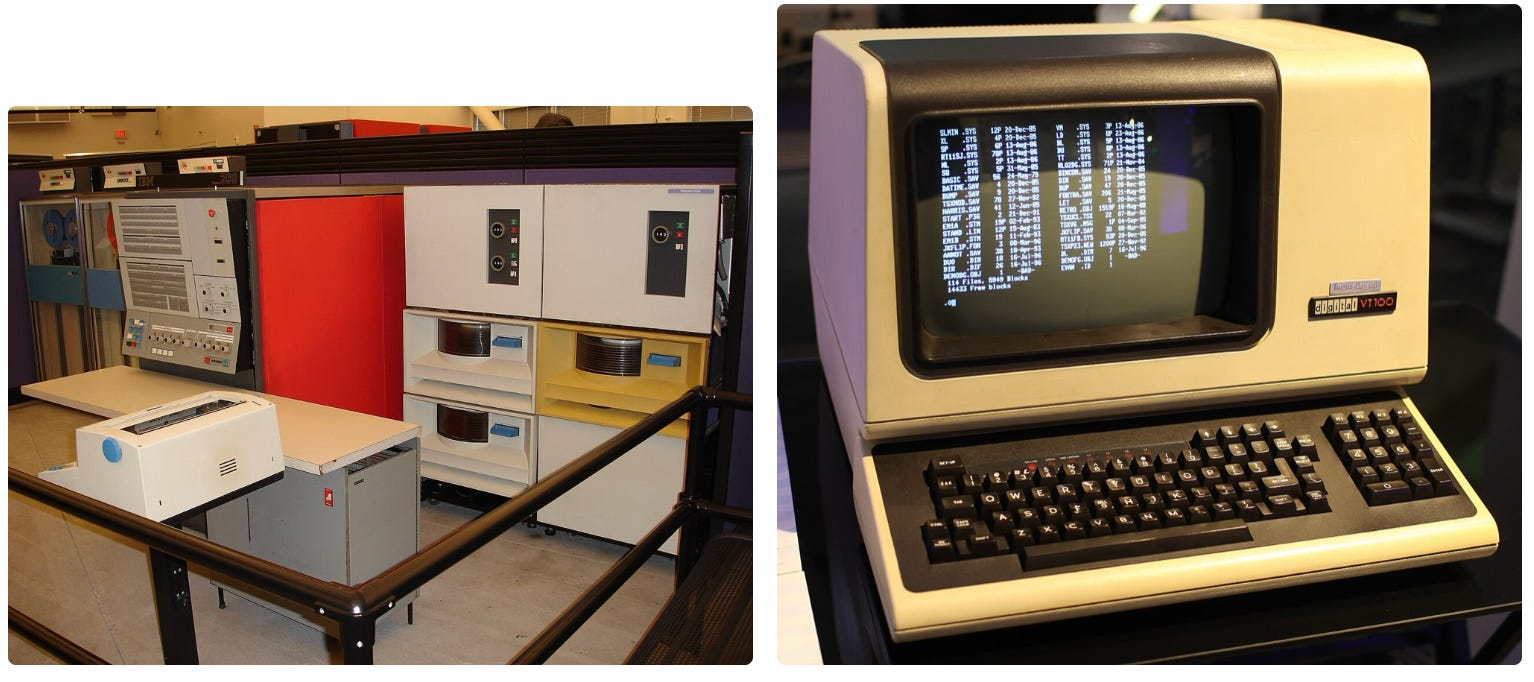

Where it went: the personal computer (IBM PC 5150, 1981) and the phone (the original iPhone, 2007). Photos: Wikimedia Commons, CC BY-SA 3.0; Andrew from London, CC BY-SA 2.0.
The business model moved along with it. Early on, software was bundled with the hardware. After IBM unbundled software pricing in 1969, enterprise software settled into a familiar pattern: a large up-front perpetual license, followed by an annual maintenance agreement that often ran around a fifth of the license price, every year, for as long as you used it. Big checks, long sales cycles, and a vendor that owned the relationship.
Around 2000 the market began to shift to what was first called the ASP model, for application service provider, and later software as a service. Customers stopped buying the software and started renting access to it, hosted by the vendor, over the internet. I was in the middle of that transition, with all of its frustrations. Customers didn’t trust their data on someone else’s servers, procurement departments didn’t know how to buy a subscription, and finance teams didn’t know how to recognize the revenue. It took years. Then it became the default, and today most people never think about where their software runs.
Open source ran alongside all of this. Richard Stallman launched the GNU project in 1983, Linus Torvalds released Linux in 1991, and the term “open source” was coined in 1998. What started as a movement became the plumbing of the internet. Companies pulled open source in, validated it, and ran it in production without paying a license fee to anyone. Then the pendulum swung back. Large companies don’t want to be software companies. They know that building their own software, or even running open source, takes support and personnel, and they would rather farm that out. That’s how a company like Red Hat built a business selling support for free software, and why IBM paid $34 billion for it in 2019.
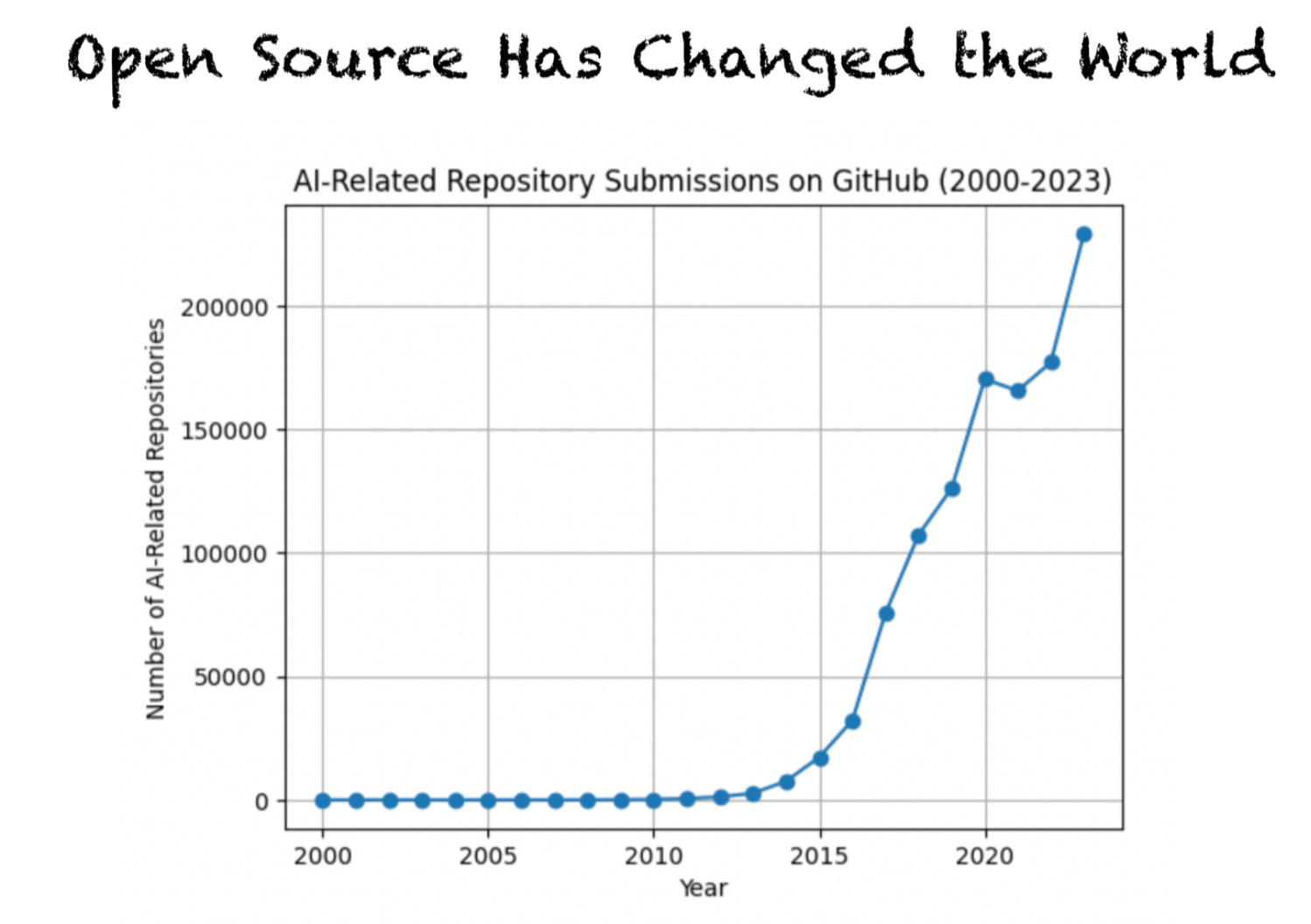
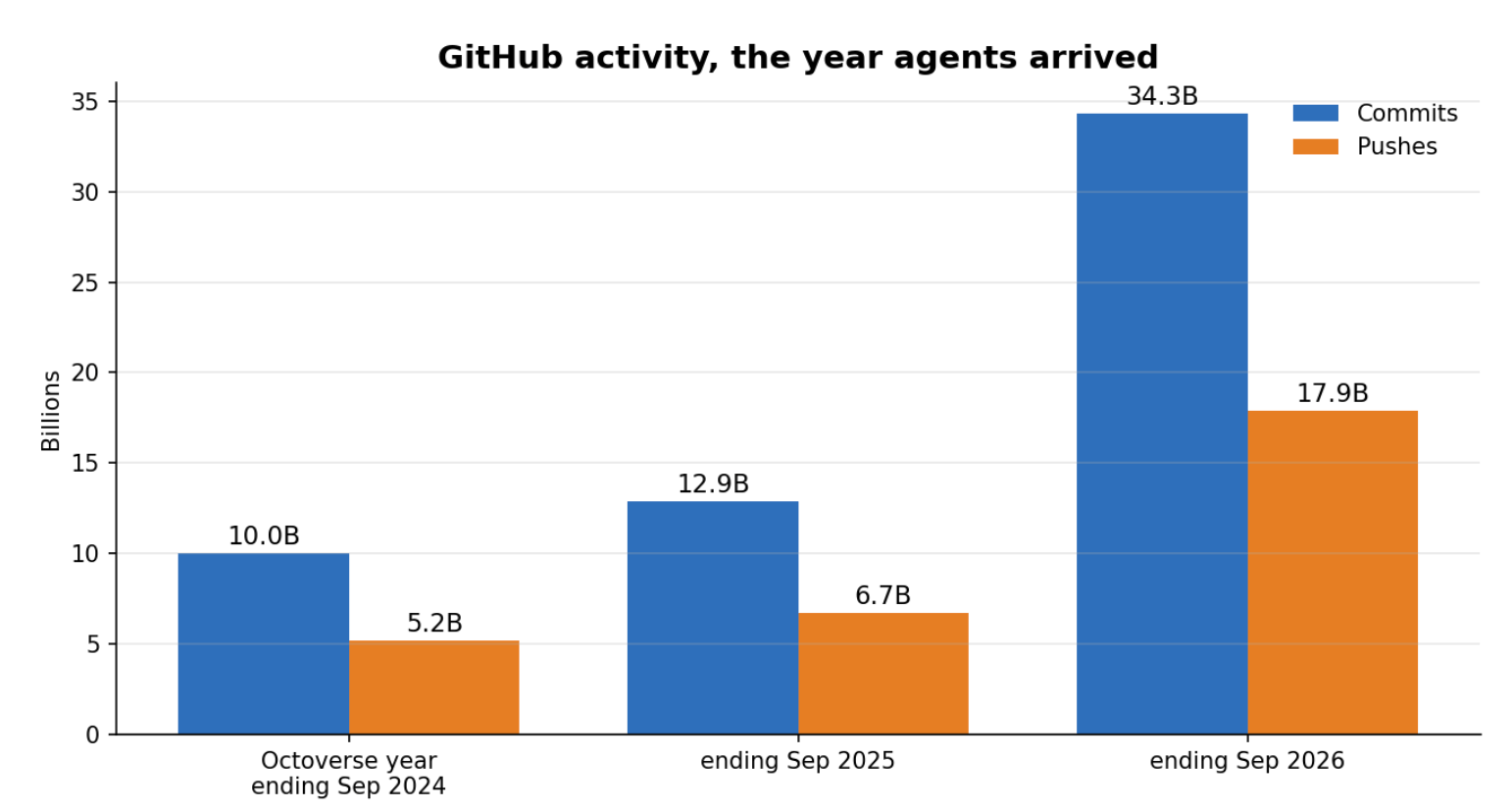
Open source didn’t slow down after that slide. GitHub’s own Octoverse reports now count about 4.3 million AI-related repositories, and more than 1.1 million public repositories import an LLM SDK, up 178% in a year. The 2026 report is more striking still. Commits on GitHub reached 34.3 billion in the year ending September 2026, more than double the year before, and by September more than 40% of pull requests started from an agent’s first draft. The software is writing the software now.
Here’s where I think this goes. Agents are going to set off an explosion of small businesses. Yes, there will be massive companies, but there will also be many, many small ones: a handful of people, or one person, with a set of agents doing the work a department used to do. Collectively they will start to dominate the trade. Then the big companies will aggregate them, conglomerate them, accrete them together, and the cycle goes on. On the business model side I expect the same rhythm we’ve already lived through: perpetual license, software as a service, in-house, rinse and repeat. What doesn’t repeat is the assumption that all of it has to run in someone else’s giant building.
Why the compute is going to move out of the cloud, not deeper into it
Here’s where the privacy argument closes the loop. Businesses are not going to keep shipping their proprietary content (their research, their contracts, their customer data, their trade secrets) into a frontier lab’s cloud forever, especially once they understand how cheap it is to run equivalent capability in-house. We’ve already seen the early version of this fight: mathematicians and researchers pushing back on having their unpublished work ingested by a model they don’t control, companies pulling data out of tools they don’t trust, legal teams starting to ask hard questions about what their vendor’s terms of service actually say about training rights.
Good models that run locally, cheaply, on modest hardware, chained together into pipelines you own, over your own content, behind your own firewall: that is where the demand is going to concentrate. It’s the same move software made from the mainframe to the desktop. The direction of travel is away from hyperscale, and that’s the opposite of what a trillion dollars of new data centers assumes.
The data center story was never really about data centers
So why are hyperscalers borrowing hundreds of billions of dollars for infrastructure, if the compute math doesn’t support it? Because private equity, which used to fund this kind of buildout, has pulled back. The risk-adjusted returns don’t pencil out for people who actually have to underwrite the math. So the money is coming from debt offerings instead, sold to public markets, to retail investors, to mom-and-pop shareholders who hear “data center” and “AI” in the same sentence and assume it must be a sound, inevitable bet. It’s a capital-raising strategy dressed up as an infrastructure strategy.
I don’t think the bulk of these debt-financed billions ends up built out as advertised. Some of it will go to data centers, sure, but watch where the rest goes over the next few years. I’ll put it plainly: this will become obvious in hindsight, the same way every previous cycle of “this exponential never ends” became obvious in hindsight once it ended.
NVIDIA is the canary, and the correction isn’t over
Jensen Huang’s exit is not the cause of NVIDIA’s trouble. The stock had already shed close to two trillion dollars before his personal conduct became the story the press could run with. The real issue underneath that selloff is simple: the market priced NVIDIA for a world where massive, continuously scaling training compute is the permanent, ever-growing demand driver. That world assumed labs would need exponentially more parallel compute, forever, to keep shipping bigger models. That assumption is wrong. The real demand curve is inference and orchestration, which needs a fraction of the hardware, running on a widening set of chips from other vendors. NVIDIA will recover eventually. It’s still an excellent company with real technology. It won’t recover until the market finishes repricing it around what the AI industry needs going forward, rather than what it needed during the training land-grab.
Where the frontier labs are actually placing their bets
Here’s the part that should really get your attention: the frontier AI labs appear to already know their current business model doesn’t have forever left in it. That’s why Anthropic has been moving, aggressively, into becoming a drug company: acquiring a computational drug discovery team, signing clinical and commercial partnerships with major pharmaceutical players, standing up its own in-house preclinical programs. I wrote about this in detail here, and the pattern has only deepened since. OpenAI appears to be eyeing the same trillion-dollar prize.
The companies best positioned to win that prize are Alphabet, and even Meta, more than the pure-play AI labs. They sit on enormous stores of proprietary, longitudinal data, years of search, health, behavioral, and real-world signal that is exactly the raw material drug discovery and healthcare AI need, and that a model trained from scratch simply does not have. Data moats, not model size, win this next phase too.
The actual bottleneck in pharma was never the computational discovery step. It’s clinical trials, the slow, expensive, necessarily careful process of validating safety in humans. AI is going to bring real insight to that pipeline, and we are nowhere close to AI replacing the human-safety validation process itself. That’s a big enough topic for its own piece, and I’ll write it.
The next chapter is already on someone’s desk
Don’t get pulled into the story that more data centers are the inevitable next chapter of AI. Software already showed us how this goes: it starts on the big iron, it moves to the machine on your desk, the business model swings back and forth, and the people who own the content win. The next chapter is already running on a Mac Mini on someone’s desk, gluing a handful of already-excellent models together, over content nobody else gets to see.

Steven Muskal, Ph.D. is the CEO of Eidogen-Sertanty, Inc. — a drug discovery informatics company. He has spent four decades working at the intersection of computational biology, AI, and drug discovery. He writes about AI, health, and the intersection of biology and technology at stevenmuskal.com