


By Steven Muskal, Ph.D. | May 13, 2026 | stevenmuskal.com
The Long Arc
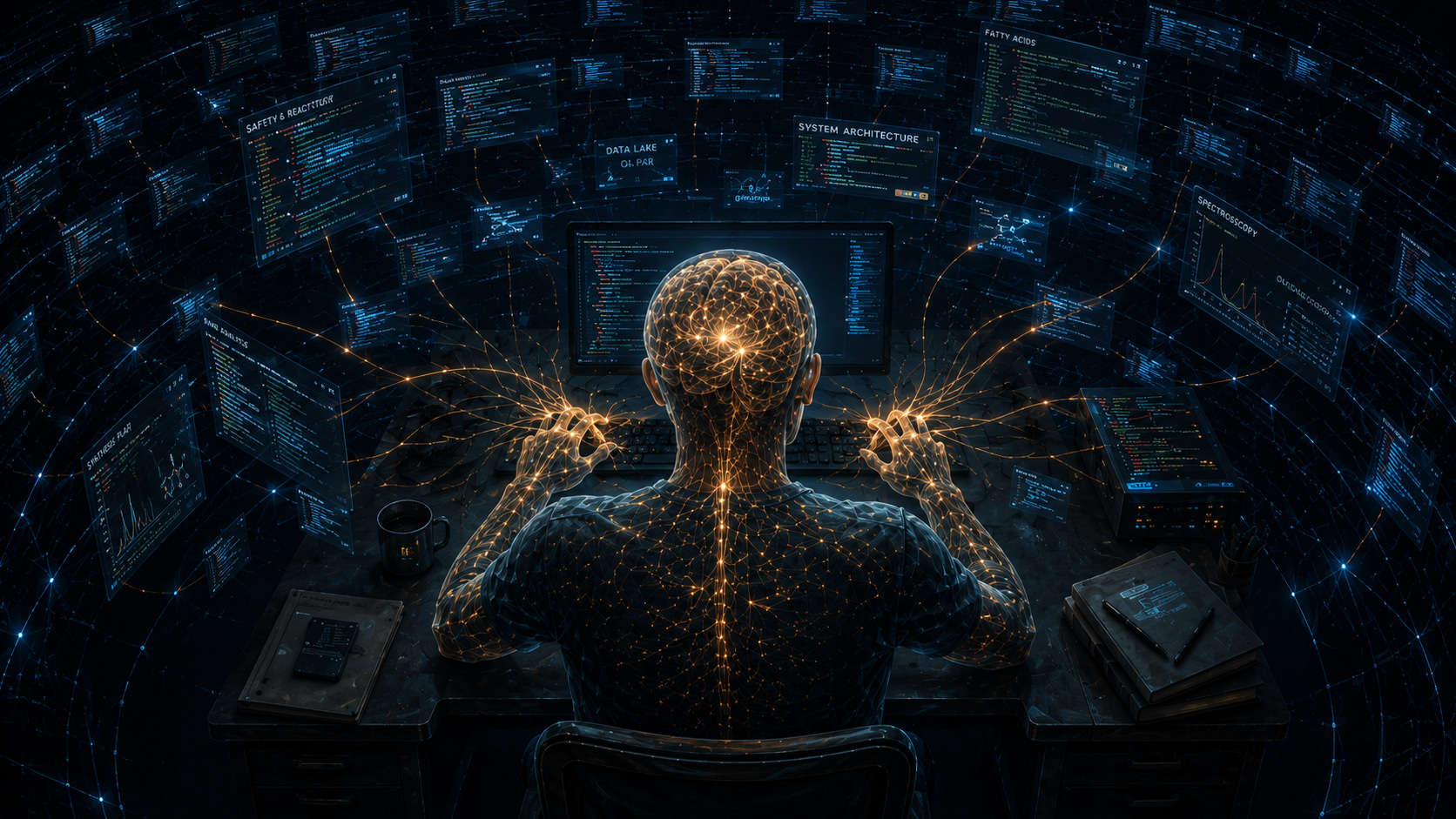
In the late 1980s, I was spending twelve to sixteen hours a day inside neural network systems at UC Berkeley. Not using them. Building them. My graduate work involved developing tools to make neural network training more efficient, contributing to the foundational methodology that would, decades later, quietly underpin a great deal of what we now call artificial intelligence. The work was deliberate, deep, and computationally demanding in ways that are almost quaint by today’s standards. We were doing significant things on hardware that modern inference workloads would run circles around without breaking a sweat.
There is a meaningful distinction that tends to get lost in current media coverage of AI: training a model and using one are categorically different activities. Training requires massive GPU clusters, enormous datasets, industrial energy consumption, and months of coordinated effort. Inference, using the trained model to respond to a query, is comparatively lightweight. That asymmetry has enormous implications for how AI spreads and scales, but the coverage rarely distinguishes between the two, which leaves most people with a distorted sense of what the resource footprint actually looks like. I spent my Berkeley years in the heavy-lifting phase. I know the difference from the inside.
After the methodology was built, the dynamic shifted. Leveraging it required far less time than constructing it had. Applications came quickly. You build the engine once; you drive it many times. Over the decades that followed, my engagement with AI systems followed that pattern: significant front-loaded investment, followed by relatively efficient deployment. The curve flattened. The ratio of time-inside to output improved dramatically. This mirrors the broader arc of any foundational technology, where the bulk of the effort is in the establishment, not the execution.
Then, roughly three years ago, something inverted.
With the arrival of mature large language models and CLI-accessible tools, my time spent inside AI systems surged back toward early-career levels. Not building, this time. Using. Claude CLI running with ` — dangerously-skip-permissions`, Codex working through complex engineering tasks, Factory AI’s Droid orchestrating multi-step workflows, and Gemini CLI configured to `approve-all` to maintain uninterrupted flow state during demanding sessions. Hours that used to look like engineering have been replaced by hours that look like… something harder to categorize. The inputs are different. The cognitive mode is different. But the time commitment has returned to something that would have been familiar to the version of me sitting in front of a workstation in Berkeley in 1988.
That U-shaped curve, enormous time, then much less, then enormous again, is precisely where this becomes interesting to think about. Because I am not a newcomer arriving at AI with fresh eyes and no reference point. I am someone who has spent four decades living inside these systems in various forms. And that, it turns out, is exactly what makes the draw observable in ways it might not otherwise be. The hook is most visible to someone who has seen it from multiple angles over a very long time. Not despite the expertise, but because of it.
Dopamine Businesses
Let me say directly what I think is happening, because the framing matters more than any particular observation I can offer.
Dopamine businesses are not a new invention. Dopamine, the neurotransmitter that drives anticipatory wanting rather than simple pleasure, is as old as human biology. We have always used it on each other. Gambling is a dopamine business. Alcohol is a dopamine business. Narrative fiction, gossip, ritual, romance, commodity markets, the architecture of casinos designed to remove your sense of time passing, the engineered unpredictability of a slot machine’s reward schedule: all of them operate on the same underlying circuitry. The circuit evolved because it was adaptive. It pushed our ancestors toward food, toward social connection, toward novel information, toward the kind of environmental engagement that increased survival odds in a world of genuine scarcity.
What changed is not the existence of dopamine businesses. What changed is the engineering precision and the stimulatory load. These are related but not identical problems.
Our evolved inhibitory systems, the internal braking mechanisms that produce satiation, aversion to excess, the sensation of having had enough, are real and genuinely functional. They are not easily overridden under conditions resembling those in which they evolved. But they developed under a stimulatory environment that was, by any modern standard, quiet. Variable, unpredictable, often lean, and never continuously optimized to keep the seeking behavior running. The problem is not that the brakes are broken. The problem is that the gas pedal is now operated by systems that were engineered, specifically and at considerable expense, to apply pressure just below the threshold where braking activates. The result is a sustained, low-grade override of circuits that were never calibrated for continuous load.
Two colleagues recently published a paper on modeling cognitive overload that I think is a serious first step toward putting a quantitative frame around this problem: [The Bias Amplification Model A Mathematical Framework for Quantifying Cognitive Distortion Under Conditions of Information Overload — and their model is here: The Bias Amplification Model] The instinct to measure it is exactly right. You cannot manage what you cannot observe. The challenge is that most of us are currently operating with no real instrument for reading our own cognitive load, which means we are flying without gauges in conditions that have changed more in the last decade than in the prior century.
The Same Mechanism, Different Substrates
The most clarifying thing I can say about the current AI moment is that the operating principle behind what Big Tech built is not metaphorically similar to what Big Food built before it. They are the same mechanism applied to different substrates.
Big Food spent decades, from roughly the 1950s onward, engineering hyper-palatable products. Food scientists calibrated fat-to-salt-to-sugar ratios with extraordinary precision to maximize palatability while minimizing satiety. They engineered texture profiles that felt compelling without triggering the body’s stop signal. They discovered the bliss point, the sweet spot of sweetness or saltiness that generates maximum hedonic response, and optimized relentlessly toward it. The goal, stated plainly, was to override the body’s natural feedback loop that says enough. Not through deception, exactly, but through engineering that was specifically designed to outpace the biology it was operating on.
The metabolic consequences of that project are still unfolding. I wrote about this at length in a piece on the metabolic crisis (Substack version here), but the short version is that somewhere between 88 and 93 percent of American adults are now metabolically compromised by at least one risk factor. This is not a number that comes from a single dietary mistake or an individual failure of willpower. It is the aggregate output of an industry that spent seventy years engineering food to override the satiety signals that keep metabolic health intact.
Big Tech learned from that playbook and applied it to cognition. The medium changed; the strategy did not. Engagement loops built on variable reinforcement schedules, designed to be just compelling enough that you stay but never so satisfying that you leave fulfilled. Recommendation algorithms that learned your individual response profile and calibrated content delivery to extend session time. Notification architectures engineered to interrupt your attention at precisely the moment when re-engagement was most likely. These are not rough approximations of behavioral influence. They are precision instruments, developed by teams of behavioral scientists, running on infrastructure that updates in real time based on your response.
TikTok is the clearest specimen of what this looks like at full development. The recommendation algorithm does not weight whether you said you liked something. It tracks duration watched, completion rate, sound engagement, scroll hesitation before a restart, the particular speed of your thumb as you move through content. Every one of those signals feeds a system that is continuously updating its model of what will extend your session. The content is almost incidental. It is the carrier wave for a psychological feedback loop that has been built with billions of dollars of engineering investment. Facebook Reels followed nearly the same architectural blueprint. You do not choose your echo chamber on these platforms. The platform builds it around you, in real time, tuned to your individual response profile. The algorithm does not know you. It does not need to. It knows your behavioral signature well enough to accomplish the same thing.
The important thing to hold onto here is that these are not incidentally addictive products that happened to capture people’s attention. They are systems that were designed, iterated, tested, and refined specifically to maximize the duration and intensity of engagement. The dependency is a feature, not an externality.
AI as Dopamine Business
I want to be precise about this, because I think the standard framing undersells what’s actually happening.
The claim is not that AI companies sat in a room and said “let’s make something addictive.” Some of what I’m describing is structural rather than deliberate. But structurally, a well-designed LLM interaction generates exactly the patterns that sustain engagement loops, and it does so repeatedly and reliably enough that the effect is real regardless of intent.
Consider the mechanics. An incomplete response that leaves a thread unresolved, creating a pull to follow up. A step-by-step technical walkthrough that requires sustained engagement across multiple iterations before any deliverable appears. An overwhelming first-pass answer that is genuinely useful but also genuinely too large to absorb, which prompts you to ask for synthesis, starting a new loop. For those of us oriented toward critical thinking, the occasional wrong answer that you catch, and then find yourself interrogating, pulling you deeper into the exchange in the course of correcting it. Each of these is a mechanism. Each creates an incomplete reward cycle that sustains engagement precisely because it is incomplete.
I run Anthropic’s Claude, OpenAI’s Codex, Factory AI’s Droid, and occasionally Google’s Gemini, all via command line, all as deeply integrated layers in my daily work. This is not casual or exploratory usage. These tools are woven into the architecture of AI-Steve (Substack version), a comprehensive personal AI system I’ve built and documented that runs across my email, calendar, health data, code, and knowledge base. The second piece in that series (Substack version) covers how the system now proposes its own extensions, which should give you a reasonable sense of how far down this path I have gone and how deliberately I have gone there.
The economics of this are also worth naming. These systems often begin free and escalate. Heavy usage across multiple platforms is not unusual at $200 per month per subscription, or more. That spending feels justified because the value is real. But the pattern of spending, the shape of it, tracks something that goes beyond a rational productivity calculation. I recognize the pattern from other contexts. The value justification and the dependency are not mutually exclusive. They coexist quite comfortably, which is part of what makes it worth paying attention to.
The draw is genuinely bidirectional, and this is important. The model pulls you in through its mechanics. But your own psychology pulls you toward it at the same time. The more capable the system, the more problems you bring to it. The more problems you bring to it, the more time you spend in session. The more time you spend in session, the harder it becomes to imagine working at the same pace without it. That loop has an acceleration to it that is not purely about the tool. Some of it is about what happens to the user.
Session Saturation and the Successor Prompt
There is a practical dimension to heavy AI usage that does not get discussed enough, in part because it requires extended experience to observe clearly.
These systems degrade during long sessions. Not catastrophically, and not in ways that are always obvious in the moment, but in ways that accumulate. If you are deep in a working session of two or three hours, the model begins to show what I can only describe as fatigue. It starts revisiting ground that was already covered. It generates responses that are technically coherent but increasingly approximate. It loops back to early-session framings even when the conversation has moved past them. The context window is working hard with more history than it handles gracefully under sustained load. The session is saturated.
When I notice this happening, I use what has become one of the more reliable techniques in my workflow. I give the model a prompt approximately like this: ”Fully document everything we have done so far and generate a prompt for your successor. I want to start a new session.” The model produces a comprehensive handoff document. I close the session entirely, open a new one, and paste that document as the opening message. The new instance has the benefit of context without the accumulated weight. It is, as I have come to think of it, giving the AI a night of sleep. The clarity difference when you return to a problem that way is immediate and noticeable.
There is a related observation I am somewhat less comfortable sharing, but it is accurate. I have found that off-hours usage tends to yield meaningfully better results, responses that feel less throttled, more precise, less prone to the fuzzy approximations that suggest something is being managed on the backend. Peak usage periods seem to correlate with subtly degraded quality. So I have started timing my most demanding sessions for early morning or late at night, when the systems are less congested.
I recognize what this sounds like. It sounds exactly like someone timing their purchases to get better quality at lower friction. The junkie who knows which hours the dealer is freshest and plans accordingly. I am not being dramatic. The behavioral pattern is structurally identical. The fact that the activity is productive does not change the shape of the dependency, and I think the honesty of that comparison is worth sitting with rather than deflecting.
Biological Inhibition and the Overwhelmed Brake
Here is something that consistently gets underappreciated in discussions about digital dependency: our inhibitory mechanisms are real, evolved, and functionally capable. The problem is not that they are broken. The problem is the environment they are operating in.
The wanting system and the braking system are paired. Dopamine drives approach. Satiation, aversion, discomfort with excess, the physical signal that says stop, these counterweights are built in. They work. They kept human beings from bingeing themselves into dysfunction across hundreds of thousands of years of evolutionary history, in environments where stimulation was scarce, variable, and predominantly low-intensity.
That environment is gone. The systems we have engineered, processed food, algorithmic social media, AI engagement loops, are high-intensity, continuous, and deliberately calibrated to operate just below the threshold where the braking mechanisms activate. This is not accidental. It is the target. Build something compelling enough to sustain engagement but not so aversive that it triggers a withdrawal response. The result is a sustained low-grade override that is genuinely novel in evolutionary terms. Our ancestors never faced anything like it at this scale or consistency.
The cognitive overload modeling work referenced [here] is trying to put a quantitative frame around what happens when that load accumulates. That is exactly the right direction. The challenge is that most of us are currently managing without any real read on where our cognitive load sits, which means we are making trade-off decisions without instruments. The Bronze Age analogy I return to: warriors of that era wore armor calibrated to the weapons they faced. When the weapons changed, the armor became inadequate. Not because armor was a bad idea, but because the threat had outpaced the protection. We are in a comparable situation. Our evolved inhibitory systems were calibrated to a prior environment. The dopamine businesses now operating at industrial scale are a different category of threat, and managing them with unmodified biology is asking the wrong tool to do the job.
The Glasses Problem, and What Hormetic Stress Has to Do With It
I have worn corrective lenses for most of my adult life. During engineering school, my prescription kept escalating. Not because anything medically unusual was happening, but because I was in front of a workstation for twelve-hour stretches, and my eyes were adapting to continuous close-focus demand. Each new prescription would feel right for about a week, then my vision would adjust around the correction and the glasses would feel insufficient, and the cycle would repeat. The tool was recalibrating my biology in the wrong direction. The correction was enabling a feedback loop that made the underlying capacity progressively weaker at operating without the support.
At some point I started doing something deliberate. I stopped reaching for corrective lenses reflexively. During portions of the day when the stakes of acuity were manageable, I let things stay slightly out of focus rather than immediately compensating. This was uncomfortable in a predictable way. But over time something interesting happened: my vision adapted. Not to perfect acuity, but to meaningfully better function without constant correction. The underlying capacity, deprived of the crutch, had room to operate and to recover some of what the crutch had been compensating for.
This is a well-documented principle in physiology under the name hormetic stress, the idea that strategic, controlled withdrawal from a support system can strengthen the underlying capacity that the support was masking. Intermittent fasting, cold exposure, graduated resistance training: all operate on some version of this. The temporary discomfort is not the point. The adaptation is.
I think about the glasses problem with some regularity when I consider AI dependency. The risk is not that AI makes my thinking worse during a session. By most measures, it makes it better, faster, more comprehensive. The risk is the longer-term trajectory: whether continuous delegation gradually atrophies the underlying capabilities being delegated. Not suddenly. Not obviously. In the way that a muscle you stop loading eventually loses the functional range you had come to take for granted. You don’t notice until you need it.
For any system where biology is involved, where the support is operating on top of a biological capacity rather than simply replacing a mechanical one, the question of what happens to the underlying capacity under conditions of sustained offloading is a serious question. It does not resolve itself just because the support is valuable. The glasses escalated while delivering genuine utility. The utility and the atrophy were coexisting.
The practical implication is not to abandon the tools. It is to build in deliberate resistance: working through important problems in your own head before asking the model, checking your intuition before comparing it to the AI’s framing, maintaining the habit of thinking hard about something without autocomplete for your thought process. Not as a purity position. As maintenance.
The “Too Big to Fail” Threshold
We have seen this transition before, in different contexts.
Financial institutions, somewhere in the decade before 2008, crossed a threshold where their interconnection with the rest of the economy had become deep enough that their individual failure was not just a problem for them. It was a systemic destabilizer. “Too big to fail” does not mean deserving, or right, or particularly well-managed. It means the cost of the absence has grown larger than the cost of the continued presence. The institution has become structural. Removing it does more damage than sustaining it.
Certain platform businesses crossed a version of this threshold around the same period. When commerce, communication, identity verification, and community infrastructure are routed through a single platform at sufficient scale, opting out is no longer a meaningful option. The decision is no longer about whether you endorse the product. It is about whether leaving is less disruptive than the problems that come with staying. The platform has become infrastructure. Infrastructure does not get evaluated on its merits in the usual way.
AI is following the same trajectory. It is doing so faster than either of those precedents, and across a broader set of domains simultaneously, which is what makes this moment genuinely different from the comparable moments in fintech or platform media.
Consider the concurrent integration: AI is now load-bearing infrastructure in software development, where its absence would materially slow output across the industry. It is embedded in business decision support in ways that are difficult to disentangle from the decisions themselves. It is a functional creative partner in content, media, research, and communication. For individuals operating across multiple disciplines, as I do, it is a thinking amplifier that has been woven into the cognitive architecture of daily work. None of these applications, taken alone, crosses the threshold. Together, the accumulation changes the character of the dependency.
The critical threshold is not about capability. It is about when the absence of something becomes more destabilizing than its presence. I believe that threshold has been crossed, without ceremony, without a moment anyone could point to, and without the coordinating frameworks that might help us understand what we are navigating. It happened in the accumulation of individual dependencies, each of them reasonable in isolation, that collectively produced something with a very different character.
The Illusion of Control
There is a quality to working inside AI systems that feels like a tight feedback loop between your intent and the output. You frame the prompt. It responds. You refine. It adjusts. The iteration is fast and the responsiveness is real. It feels, in the best moments, like a very capable extension of your own thinking.
But underneath that feedback loop, you are operating inside a system with constraints you do not fully see and did not negotiate. Training data assembled by decisions you were not part of, reflecting priorities that were not yours. Model updates deployed on schedules you do not set, in ways that are not announced, that shift behavior in ways you might not notice unless you have been using the system long enough to have built a baseline. Safety filters and content policies that shape outputs in ways that are invisible until they are not. Architectural choices made years ago, by teams working with assumptions about what a useful AI should do that may or may not match what you actually need. You are operating a complex system to which you do not have access to the hood. That is fine for most purposes. You do not need to understand the combustion cycle to get where you are going.
It becomes less fine when the system is load-bearing. When your strategic thinking, your code, your communications, and your framework for evaluating new problems are all routed through infrastructure you cannot fully audit, the trust is implicit and largely unexamined. I am not suggesting that should be a reason to stop, but it should at minimum be conscious. The distinction between using a tool and being embedded in infrastructure is not one we tend to make in real time. It tends to become visible only in retrospect.
What AI Does to Gut Instinct
This is the part that concerns me most in the long run, and it is also the most difficult to measure, which is itself part of the problem.
The best decisions I have made in my career, the ones that look cleanest in retrospect and held up under conditions I could not have anticipated, rarely came from analysis alone. They came from pattern recognition built over decades of being wrong in similar situations. From a specific quality of discomfort that consistently precedes a bad deal. From sensing misalignment in a conversation before the data had confirmed it. From a kind of informed intuition: not arbitrary, not mystical, but deeply calibrated to a large accumulated sample of outcomes. That kind of knowing does not come from structured reasoning. It comes from having been in the room, made the call, lived with what followed, and done it again many times.
AI is genuinely excellent at structured reasoning. Given a well-defined problem and adequate information, it will often produce faster and more comprehensive analysis than I could produce alone. That is real, and I rely on it.
But lived intuition is not structured reasoning. It operates through a different mechanism, built from a different substrate, and it does not transfer as a data set. You cannot prompt-engineer your way to pattern recognition that took thirty years to develop. And if you spend enough time outsourcing the reasoning process to an external system, the internal version of that capacity follows the biological logic of disuse. Not dramatically. Not in a way that announces itself. In the gradual, quiet way that any capability fades when you stop exercising it.
I try to stay ahead of this by going through important decisions on my own first, before I bring in the AI, before I compare its framing to mine. Not as a ritual. Not as skepticism about the tools. As deliberate maintenance of a capability I am not ready to trade away, particularly given that the trade would be invisible until it was already complete.
A Personal Checkpoint
For what it’s worth, here are the four questions I’ve settled on as a working audit for my own situation:
Am I using AI to amplify my thinking, or replace it?
Am I still capable of doing the work without it, even if slower?
Am I asking it to challenge me, or just to execute?
Am I aware of where it is likely to be wrong?
None of these have permanently right answers. The answers shift depending on the day, the task, and the context. That is the point. They are meant to be revisited regularly, not resolved once and filed away.
The Uncomfortable Conclusion
I am not going to stop using these tools. The value is real, the integration is deep, and the capability gap between what I accomplish with them and what I would accomplish without them is too significant to voluntarily close. AI-Steve is a hundredfold increase in productive output, and that is not a number chosen for effect. It reflects something accurate about what happens when a system trained on four decades of your own reasoning patterns is deployed across every domain you work in.
But I think honesty is warranted here in a way it rarely is. Not alarm. Honesty.
AI has become cognitive infrastructure faster than we have developed any framework for thinking about what that means. The dopamine mechanics are real, structural in some cases and deliberate in others, but operative regardless of origin. The biological inhibitory systems that are supposed to moderate our engagement are working well below their design load in an environment they were never calibrated for. The gut instinct atrophy risk is real and invisible in real time. And the “too big to fail” threshold, the point at which AI’s absence would be more destabilizing than its continued presence, is not approaching. It has already been crossed.
The answer is not strategic retreat. It is measurement, awareness, and deliberate practice: knowing your baseline, tracking what is changing, building in periodic resistance, staying honest about what you are trading away. The same principles that apply to managing any other system of dependency, where the dependency is real, the value is real, and the two coexist in ways that require active navigation rather than passive acceptance.
I do not have a clean solution. I am working it out in real time, as most of us are. What I am more confident about is that the people who will navigate this most effectively are the ones willing to name it accurately: not only a productivity revolution, but a fundamental cognitive reorganization happening at a speed that outpaces any framework we have for thinking about it. Building deliberately inside that reorganization requires seeing it clearly.
Drop a comment. Tell me how you are managing it, what is working, what is not, whether you have found strategies I haven’t thought about yet. I am genuinely interested in what people are discovering. This is a conversation worth having, not a conclusion worth broadcasting.
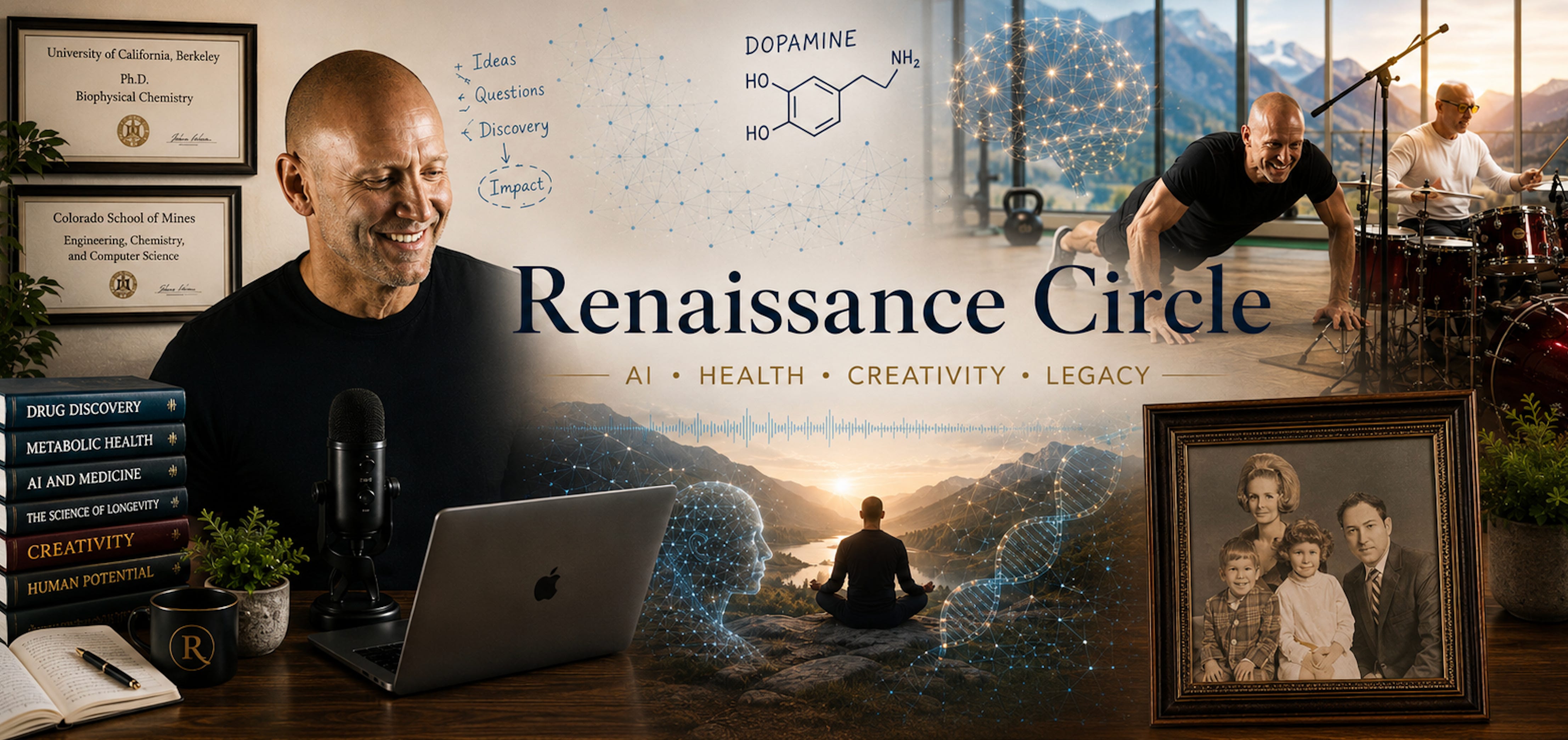
Steven Muskal, Ph.D. is the CEO of Eidogen-Sertanty, Inc. - a drug discovery informatics company. He has spent four decades working at the intersection of computational biology, AI, and drug discovery. He writes about AI, health, and the intersection of biology and technology at stevenmuskal.com
For a couple music mix vids — we had a fun mix with a new crew to ORanch {except for Johnny Conga helping me to hold things down} — RonF (vocals/guitar), TimL (Bass/Vocals), Steve (Guitar), Johnny (Congas). It’s always fun when brand new people plug, play, and groove on songs new and have fun doing it! Tim and Ron co-authored the above paper:
An excerpt from The Atlantic that you may find interesting.
Too Much Is Happening Too Fast
The AI boom is meant to overwhelm you.
By Charlie Warzel
"Elsewhere online, programmers are beginning to describe an affinity for coding agents that is veering into unhealthy territory. “I’m up at 2AM on a Tuesday,” Anita Kirkovska, the head of growth at an AI company, wrote recently, “not because I have a deadline, but because Claude Code made it so easy to keep going that I forgot to stop.” She describes a “competence addiction” caused by the tools making her so productive: “You hit a prompt, the agent succeeds, you get a dopamine hit. The agent fails spectacularly, you get adrenaline. Both are reinforcing. Both keep you at the terminal.” Kirkovska argues that she sees this among all kinds of AI power users—an unsustainable flow state in which decision making begins to falter and people become sloppy as they grind away."
https://www.theatlantic.com/technology/2026/05/too-much-happening-too-fast/687177/?utm_source=feed
Thank you Steven for writing about these questions. My feeling is we have been moving down the road towards cognitive reorganization for a while with social media, and AI use. I agree we have to remain curious and question how we use these tools and if we are guiding problem solving or being led by AI. When it is not possible to understand how and why AI comes to conclusions or solutions, the level of risk can increase as dependance on AI for critical systems control is used.